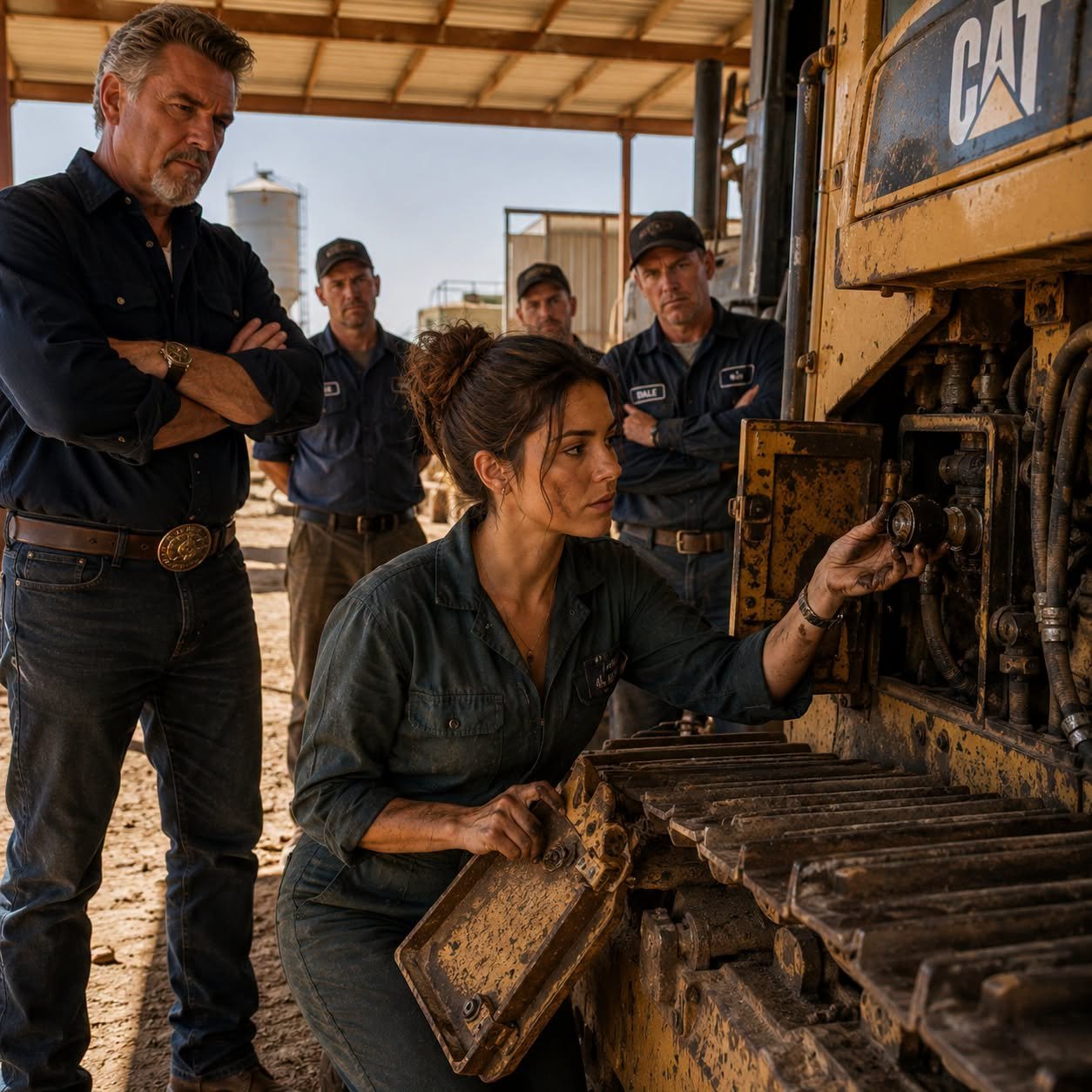
The first thing he said when he saw me was, “You’re the mechanic?”
Not hello.
Not thank you for coming.
Just those three words, spoken loud enough for every man in the machine shed to hear.

Then he laughed.
I stood under the brutal West Texas sun in my clean denim coveralls, my toolbox in one hand, my late father’s silver pocket watch in the other, and looked straight at the millionaire rancher who had already decided I was a joke.
“My name is Lena Morales,” I said. “And yes, I’m the mechanic.”
William Barrett owned 18,000 acres outside Midland, three cattle operations, two oil leases, a private airstrip, and enough ego to shade half the county. His ranch was the kind of place men spoke about with admiration and fear. White fences. Steel barns. New trucks. Quarter horses worth more than houses.
And in the middle of all that wealth sat one dead machine.
A yellow Caterpillar D4 bulldozer, parked under a tin-roof shed like a wounded animal, its hood open, its steel tracks sunk slightly into red dust.
It had not moved in three weeks.
Four mechanics had tried.
Four mechanics had failed.
Bill Barrett had lost more than $20,000 in stalled work, missed hauling schedules, and repair guesses that led nowhere.
The only reason I was standing there at all was because his younger brother, Sam, owned the neighboring ranch where I had worked for two years.
“Lena,” Sam had told me on the phone, “my brother is stubborn, rich, and convinced money can buy competence. Go prove him wrong.”
I almost said no.
Not because I feared the machine.
Machines made sense.
People were harder.
Especially men like Bill Barrett, who looked at a woman with grease under her nails and saw an insult before he saw a skill.
His lead mechanic, Rick Donovan, stood beside him with three others in matching blue work shirts. They watched me the way men watch a storm cloud they are certain will pass without rain.
Bill crossed his arms.
“Rick here spent twenty-seven years working heavy equipment,” he said. “Failed. Dale’s certified by Caterpillar. Failed. Mike and Trevor both said the transmission is shot. Three weeks. Thousands in diagnostics. But Sam says you can look at it.”
He paused, smiled, and added, “So please, Miss Morales, educate us.”
A couple of the men chuckled.
I felt my face warm.
Not with embarrassment.
With memory.
My father, Miguel Morales, had taught me engines before he taught me how to drive. He ran a little repair shop near Lubbock with two bays, cracked concrete floors, and a radio that only played old country songs. He never had fancy certificates on the wall. He had something better.
Patience.
“Machines don’t lie, mija,” he used to say. “People guess. Machines tell the truth. You just have to listen longer than your pride wants to.”
He died when I was twenty-one, right there in the shop, a wrench still in his hand. A heart attack took him before the ambulance arrived. After that, my mother took sewing jobs from home, my little brother stayed in school, and I started walking into repair shops asking for work.
Most of them laughed.
One man told me, “Sweetheart, customers don’t want a girl under their truck.”
Sam Barrett had been different.
He pointed at a broken tractor and said, “Fix that, and I’ll hire you.”
I fixed it in forty-three minutes.
Now, three years later, I was standing in front of his brother, trying to ignore the weight of every smirk in that shed.
I set my toolbox on the ground.
“May I start it?”
Bill gestured dramatically toward the bulldozer.
“Be my guest.”
I climbed into the operator’s seat, turned the key, and listened.
The diesel engine roared awake.
Clean rhythm.
Strong compression.
No cough. No hesitation. No uneven knock.
The engine was not the problem.
I shut it off and climbed down.
“The motor is healthy,” I said.
Rick snorted. “We know that.”
“I figured you did.”
I walked around the machine slowly. The tracks were packed with dust but not jammed. No fresh oil beneath the frame. No obvious hydraulic leak. The transmission casing was dry.
Bill called from behind me, “You planning to stare it into working?”
I did not answer.
I checked the main hydraulic pressure. Normal.
I checked the linkage. Normal.
I asked the operator, a quiet man named Luis, exactly what happened when it failed. He told me the dozer had run fine in the morning, then stopped responding after lunch. Engine still strong. Tracks dead. No grinding. No bang. Just nothing.
That mattered.
A destroyed transmission usually screams before it dies.
This machine had gone silent.
I knelt beside the lower left side of the transmission housing and wiped away a layer of red dust. There, tucked beneath a guard plate, was a small access panel held by four bolts.
Nobody had touched it in years.
I could tell by the dirt packed along the seams.
“What’s behind this?” I asked.
Dale leaned forward.
“Pilot control valve.”
“Did anyone check it?”
Silence.
Rick frowned. “That valve almost never fails.”
“Almost,” I said, “is where expensive mistakes live.”
Bill stepped closer, his mouth twisting.
“You’re telling me four experienced mechanics missed a little side panel?”
“I’m telling you I’d like to open it before you spend $18,000 replacing a transmission.”
For the first time, he did not laugh.
He looked at his watch.
“You have until noon. Then I order the replacement.”
It was 10:47.
I loosened the bolts one by one.
The panel came free with a dry metallic groan. Dust spilled from the cavity. I shined my flashlight inside and saw the small cylindrical valve, dull and crusted with red grit.
I removed it carefully, counted the turns, and held it up to the sunlight.
The tiny center channel should have been clear.
It wasn’t.
A plug of hardened oil and fine Texas dust blocked most of the passage.
Behind me, Rick whispered, “Well, I’ll be damned.”
Bill stepped closer.
His face changed.
“What is that?”
I looked at him, holding the little valve between my fingers.
“The reason your $250,000 bulldozer hasn’t moved in three weeks.”
Nobody laughed then.
Not Rick.
Not Dale.
Not Mike or Trevor.
Not Bill Barrett.
The whole shed seemed to hold its breath around that tiny piece of metal in my hand.
Bill stared at the valve like it had personally offended him.
“That little thing stopped the whole machine?”
“Yes,” I said. “The pump builds pressure. The main gauge reads fine. But the pressure can’t reach the transmission control circuit if this valve is blocked. It’s like having a strong heart and a clogged artery.”
Rick rubbed the back of his neck.
“We checked the main system.”
“I know.”
“We checked the transmission.”
“I know.”
He looked at the valve again, and this time there was no arrogance in his face. Only embarrassment.
“We didn’t check the middle.”
I nodded.
“That’s usually where the truth hides.”
Bill’s jaw tightened.
“How long to fix it?”
“If the valve isn’t damaged, maybe forty minutes. If it’s scored inside, we replace it. Part’s cheap, but you’ll lose another day waiting.”
He looked at the four mechanics behind him.
No one spoke.
Then he looked back at me.
“Clean it.”
I set up on the hood of my pickup, away from the worst dust. I poured hydraulic-safe solvent into a clean metal cup and dropped the valve inside. The liquid began turning brown almost immediately, loosening years of compacted grit and old oil.
The men watched from a distance at first.
Then closer.
That was the funny thing about people.
They mock what they don’t understand.
Then they lean in when understanding starts costing them money.
As the valve soaked, I took out my father’s pocket watch and checked the time.
11:08.
The watch had his initials engraved on the back: M.M.
Miguel Morales.
I rubbed my thumb over them.
My father had never seen me work on a ranch this big. He never saw Sam hire me. Never saw my mother stop worrying every time rent came due. Never saw my little brother, Mateo, get accepted into community college because my paychecks kept our family afloat.
But I felt him beside me anyway.
“Don’t rush what needs patience,” he used to say.
So I didn’t.
I cleaned the outside first.
Then I twisted a thin strip of lint-free cloth, wet it with solvent, and threaded it gently through the tiny channel. It came out nearly black.
I did it again.
And again.
By the fifth pass, the cloth came out clean.
I held the valve to the sun.
Light passed straight through.
Perfect.
The first breath I’d been holding slipped out of me.
I dried it completely, checked the threads, inspected the inner surface with my flashlight, and walked back to the bulldozer.
Bill followed.
“So?” he asked.
“So now we see if your transmission was ever broken.”
His face tightened at that.
I threaded the valve back in by hand, careful not to cross the threads, then tightened it with a torque wrench to the exact spec I had pulled from my notebook. Too loose and it would leak. Too tight and the housing could crack.
Click.
The wrench hit the mark.
I replaced the panel. Tightened all four bolts. Wiped my hands.
“Start it,” Bill said.
“I’ll do it.”
I climbed into the operator’s seat.
The whole yard had gone quiet. Workers from the fencing crew, cattle hands, even two kitchen staff had drifted over to watch. Somewhere outside the shed, a horse snorted. The diesel smell hung thick in the hot air.
I turned the key.
The engine roared.
I let it idle thirty seconds, then pressed the clutch and shifted into first.
Slowly, I released the pedal.
Nothing happened.
The tracks did not move.
Bill’s shoulders dropped.
Rick looked away.
My stomach tightened, but I forced myself not to panic.
Machines don’t lie.
People guess.
Machines tell the truth.
I shut the engine down and sat very still.
“What happened?” Bill called.
“Give me a second.”
I replayed every step. Valve cleaned. Installed correctly. Pressure good. Channel open.
Then I remembered.
Air.
Opening the valve had introduced air into the hydraulic circuit. It needed time to purge and rebuild pressure through the control line.
I climbed down.
“It needs to run longer,” I said.
Bill’s expression hardened again, hope making him afraid and cruel at the same time.
“Or it didn’t work.”
“It needs to purge air.”
“How long?”
“Two minutes.”
He looked at his watch.
“Two minutes,” he said. “Then I order the transmission.”
I climbed back up.
This time, I started the engine and did not shift right away.
Thirty seconds.
One minute.
The men stood still in the dust.
Ninety seconds.
I felt the vibration change beneath the seat. Not much. Just enough. Like blood returning to a sleeping limb.
I pressed the clutch.
Shifted into first.
Released slowly.
For half a second, nothing.
Then the left track jerked.
The right track caught.
And the bulldozer moved.
A deep metallic clank rolled through the shed as the Caterpillar crawled forward, slow at first, then steady, chewing into the red dirt like a giant waking from a long sleep.
A shout went up behind me.
Luis, the operator, covered his mouth with both hands.
“Holy God,” he said. “It works.”
I drove forward ten feet, stopped, shifted into reverse, and backed up smoothly. Then second gear. Then neutral.
Perfect response.
I shut it down.
The silence after the engine died was louder than the roar had been.
I climbed down, boots hitting the dirt.
Rick came to me first.
He took off his cap.
“Miss Morales,” he said, voice rough, “I owe you an apology.”
“You don’t.”
“Yes, I do. I looked at you and decided what you couldn’t know before I watched what you did know.”
That one landed.
Because that was exactly what most men had done since I was seventeen.
Dale shook my hand next. Mike asked if he could see my diagnostic notes. Trevor just kept staring at the bulldozer like he had witnessed a resurrection.
Luis touched the yellow hood with tears in his eyes.
“I thought I lost my job,” he said. “Three weeks waiting. I thought they’d blame me.”
“You didn’t lose your job,” I told him. “A dirty valve just held it hostage.”
He laughed through the tears.
Then everyone looked at Bill.
He had not moved.
He stood ten feet away, hands at his sides, staring at me with an expression I could not read.
Finally, he walked over.
Slowly.
The kind of slow that means a proud man is fighting a war inside himself.
When he stopped in front of me, his voice was lower than before.
“I was wrong.”
The yard stayed silent.
Bill swallowed.
“I was rude. I was arrogant. I assumed money had already bought me the best answers. I assumed you couldn’t have one because you didn’t look like the people I’m used to paying for them.”
He looked over his shoulder at his crew, then back at me.
“And I said that loud enough for everyone to hear. So I’ll say this the same way.”
He raised his voice.
“Lena Morales fixed in under two hours what I spent three weeks and thousands of dollars failing to understand. From now on, anyone on this ranch who treats her with less than full respect answers to me.”
No one clapped at first.
Then Luis did.
Then one of the cattle hands.
Then the whole shed filled with applause.
I hated how much it touched me.
I had not come there for applause. I had come for a job. For my family. For the quiet satisfaction of being right.
But somewhere deep down, the girl who had been laughed out of repair shops still needed to hear a room full of men admit she belonged.
Bill reached into his pocket and pulled out a checkbook.
“What do I owe you?”
“Standard diagnostic rate and labor.”
“No,” he said. “What do I owe you?”
I stared at him.
“Mr. Barrett, I don’t want charity.”
“It isn’t charity if the work earned it.”
He wrote a number and tore the check free.
When he handed it to me, I looked down.
$10,000.
My breath caught.
“That’s what I wasted on wrong answers,” he said. “Seems fair to spend the same amount on the right one.”
I almost handed it back.
Then I thought of my mother hunched over fabric under a dim kitchen light.
I thought of Mateo’s tuition bill.
I folded the check and put it in my pocket.
“Thank you.”
Bill nodded.
But he wasn’t finished.
That afternoon, Sam arrived just as the repaired dozer was pushing dirt near the south pasture like nothing had ever been wrong. He looked at his brother, then at me, and grinned.
“Told you.”
Bill actually looked ashamed.
For a long moment, the two brothers stood together under the shed. Sam, simple and steady. Bill, rich and lonely and shaken by the realization that all his money had not protected him from being foolish.
Then Bill turned to me.
“Your father taught you?”
“Yes.”
“What was his name?”
“Miguel Morales.”
Bill nodded slowly.
“A man like that shouldn’t disappear when one heart stops beating.”
I didn’t know what to say.
Six weeks later, Bill called me back to the ranch.
I expected another machine.
Instead, he took me to an empty hay barn that had been cleared out, swept, and fitted with workbenches. New tools hung on pegboards. Engines sat on stands. A faded old tractor waited in the center like a student ready for class.
“What is this?” I asked.
Bill stood beside me, hands in his pockets.
“A training program.”
I turned to him.
“For who?”
“For kids who don’t get hired because they don’t look like someone’s idea of a mechanic. Women. Poor kids. Farm kids. Anyone with hands willing to learn and a mind willing to listen.”
My throat tightened.
He pointed to the bare space above the barn door.
“I’d like to name it after your father. The Miguel Morales Technical Program. If you’ll run it.”
For a moment, I could not breathe.
My father’s name.
On a building.
On land owned by a man who once laughed at his daughter.
Life is strange that way. Sometimes the insult becomes the doorway.
“I’ll do it,” I said, my voice shaking. “But not just women.”
Bill looked at me.
“My father believed knowledge should not discriminate. Boys, girls, whoever comes ready to learn. That’s the rule.”
For the first time, Bill Barrett smiled without pride in it.
“Then that’s the rule.”
A year later, I stood in that same barn at eight in the morning, watching twelve students gather around a stripped diesel engine.
Four girls.
Eight boys.
All nervous.
All trying to hide it.
On the wall behind me hung a bronze plaque.
MIGUEL MORALES TECHNICAL PROGRAM
Machines don’t lie. Listen carefully.
My mother cried the first time she saw it.
Mateo took a picture and said, “Dad would have bragged about you to every stranger in Texas.”
Maybe he would have.
Or maybe he would have just smiled that quiet smile and handed me a wrench.
Bill changed too.
Not magically. Men like him do not become humble overnight. But he started listening before buying. Asking before assuming. He hired Rick, Dale, Mike, and Trevor to teach classes once a month, and every one of them admitted the same lesson to the students:
“Don’t let pride make you blind.”
As for me, I still fix machines.
I still carry my father’s pocket watch.
And every time a student gets frustrated, every time they want to jump to the biggest, most expensive answer, I tell them what my father told me.
Start with what you know.
Eliminate what works.
Look where nobody wants to look.
Because the problem is often small.
Hidden.
Ignored.
And waiting for someone patient enough to see it.
That day on Bill Barrett’s ranch, I did not just fix a bulldozer.
I fixed the way one powerful man saw people like me.
And maybe that was the bigger machine all along.