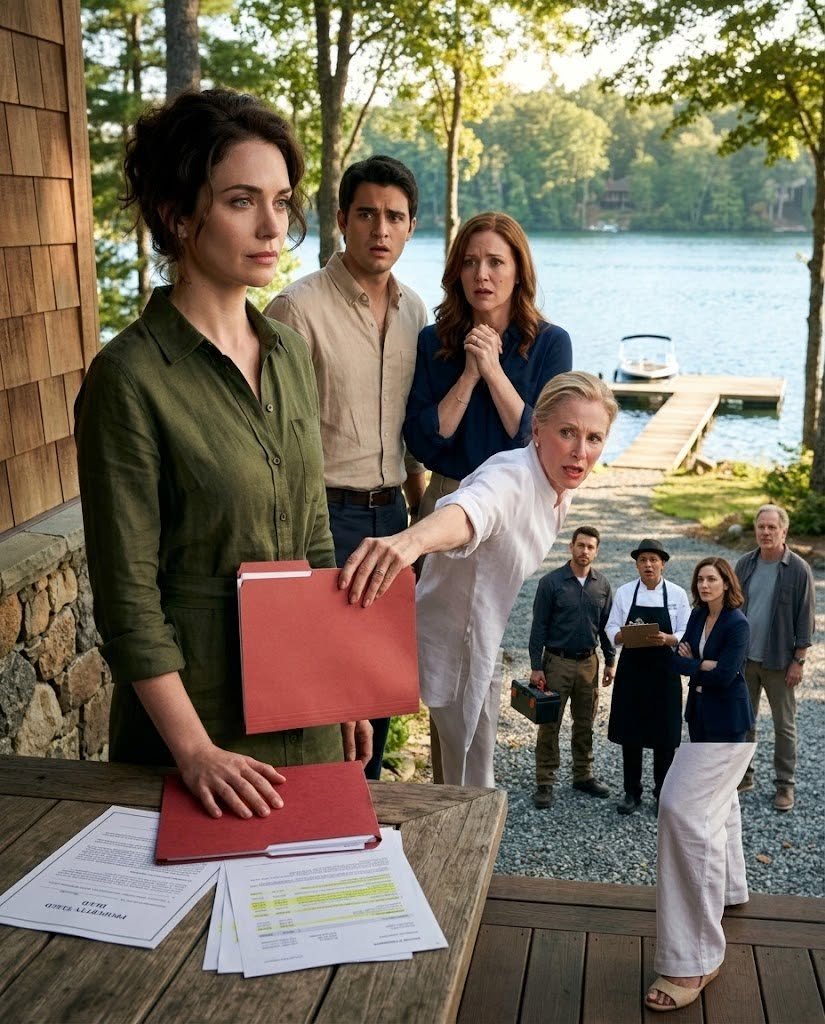
Naomi pressed play.
For one second, there was only the faint hiss of a recorded telephone line.
Then my mother’s voice filled the porch.
It was unmistakable: polished, controlled, and impatient.
“I am the trustee,” she told a bank employee.
“My daughter does not need to be involved.
Transfer the funds to the account ending in 4417.”
The recording continued.
The employee asked whether the withdrawal was for my education, as required by the trust documents.
Mom answered without hesitation.
“Yes.
Tuition and related expenses.”
Naomi stopped the audio.
No one moved.
Beyond the porch, the lake glittered under the late-morning sun.
The caterer stood near his truck with his clipboard lowered.
My realtor, Elena, stared at the highlighted bank statements.
The locksmith had quietly returned his tools to his van.
Miles looked at Mom.
“What account ended in 4417?”
She did not answer.
Naomi slid another page across the table.
It showed the receiving account’s owners: Diane and Robert Edwards, my parents.
Three days after the transfer, a cashier’s check had been issued to a luxury dealership.
The memo line contained Miles’s name.
My brother’s mouth opened, but nothing came out.
I remembered the car.
A silver convertible presented to him on his twenty-first birthday with a red ribbon across the hood.
My parents had told everyone it was a reward for his hard work at college.
That same year, they had informed me that money was tight and asked me to increase my student loans.
I had spent years repaying those loans.
Mom recovered first.
She always did.
“Your grandmother trusted me to make sensible decisions,” she said.
“Miles needed transportation.
You were already managing perfectly well.”
Naomi’s expression did not change.
“The trust did not authorize you to decide which grandchild deserved Quinn’s money.”
Dad stepped forward.
“There is no reason to turn an old misunderstanding into a public spectacle.”
I looked past him at the florist unloading white roses because Jessica had apparently instructed the staff to begin setting up before they even secured my permission.
“You brought an anniversary party, a locksmith, and a spreadsheet calculating the cost of raising me,” I said.
“You made it public.”
Jessica folded her arms.
“Can we separate these issues? Our guests are arriving this week.”
The absurdity of that question almost made me laugh.
She had just learned that my parents had diverted my inheritance to help fund her husband’s life, yet her greatest concern was still the party.
“There will be no event here,” I said.
Miles finally found his voice.
“You cannot punish Jessica and me for something Mom did years ago.”
“I am not punishing you.
I am refusing to surrender my house.”
“You know what I mean.”
I did.
In my family, boundaries were always called punishment when they inconvenienced Miles.
Mom reached for the leather folder she had brought, but Naomi placed one hand on it.
“Before you leave,” she said, “we need to address the contracts submitted in Quinn’s name.”
She removed copies of three vendor agreements: catering, flowers, and transportation.
Each listed me as the financially responsible host.
One included an electronic signature that looked like mine.
It was not.
Jessica’s face tightened.
“Those were only temporary.
We expected Quinn to approve them.”
“After you signed her name?” Naomi asked.
“The
planner needed confirmation.”
The caterer looked down at his clipboard.
“Mrs.
Edwards told us the property owner was covering the final balance.”
Jessica turned on him.
“This is private.”
“Not anymore,” he said.
Mom stared at me with the cold fury she usually reserved for people who embarrassed her in front of strangers.
“Call off your lawyer,” she said.
“Let the anniversary proceed, and we can resolve the financial questions quietly afterward.”
There it was.
Not an apology.
Not even denial.
A negotiation built on the assumption that I would surrender again.
For most of my life, I probably would have.
I had been trained to prevent scenes, smooth over conflict, and protect the family’s image.
At Thanksgiving, I changed the subject when Mom criticized my weight.
At Christmas, I paid for gifts bearing everyone’s names because Dad had forgotten to shop.
When Miles’s first business failed, I wrote his press statement and called reporters to keep the bankruptcy out of local coverage.
I had mistaken usefulness for belonging.
My birthday had finally shown me the difference.
“No,” I said.
Mom blinked.
“Excuse me?”
“The party is canceled.
The vendors will be paid for the work they have already done, but not by me.
No one from this family has permission to enter the house.
Naomi will contact you about the trust and the forged contracts.”
Miles stepped so close that Elena moved beside me.
“You would destroy our anniversary over a cabin?”
“It is not a cabin.
It is my home.
And you destroyed your event when you planned it on property you did not own.”
Dad pointed toward the driveway.
“Those vendors were promised payment.”
“By the people who hired them.”
The caterer quietly closed his clipboard.
“For clarity,” he said, looking at Jessica, “that would be you and Mr.
Edwards.”
Jessica’s cheeks turned crimson.
Mom took out her phone.
“Fine.
We will move the event to a hotel.
Quinn can reimburse us later once she calms down.”
Naomi handed her a formal notice.
“Quinn will not be reimbursing anything.
You are also instructed to preserve all records related to the trust, the vendor contracts, and any communication in which you represented yourself as authorized to use this property.”
Dad read the first page and muttered, “This is outrageous.”
“No,” Naomi said.
“It is documentation.”
A sheriff’s deputy arrived ten minutes later.
I had called the non-emergency line that morning after the security camera showed the florist’s van waiting near the road.
I had hoped my family might simply leave when asked.
Instead, they argued with the deputy about whether a daughter could legally bar her parents from a house.
The deputy answered with patient simplicity.
The deed was in my name.
They had been told to leave.
If they returned without permission, they could be cited for trespassing.
Mom looked around at the workers, the neighbor by his mailbox, the realtor, the lawyer, and the deputy.
Her humiliation was visible now, but it was not remorse.
It was anger that the audience had stopped agreeing with her.
As she descended the steps, she turned back to me.
“When this family falls apart, remember that you caused it.”
I held her gaze.
“It fell apart when love became an invoice.”
She left without another word.
The SUVs disappeared
down the gravel road.
Jessica followed in her car, still calling hotels.
The vendors packed up.
The locksmith apologized to me even though he had known nothing about the dispute.
When the driveway was empty, the silence felt enormous.
My knees began to shake.
Elena guided me into a porch chair.
Naomi brought me a glass of water from the kitchen.
“You did well,” she said.
I stared at the red folder on the table.
“I feel sick.”
“That is normal.
Holding a boundary often feels cruel when you have spent your life being rewarded for having none.”
The lake moved quietly beyond the dock.
I had imagined my first day there differently.
I pictured opening champagne, unpacking books, and watching the sunset from the porch.
Instead, I was surrounded by legal documents proving that the people who called me selfish had been spending my money since I was nineteen.
Naomi sat across from me and explained what her office had found.
My grandmother, Eleanor Edwards, had created separate education trusts for Miles and me.
Each had been funded equally.
My mother was named trustee because Grandma believed her daughter-in-law would administer the accounts responsibly.
Miles’s trust had been depleted through legitimate tuition payments and approved living expenses.
Mine had not.
Because I earned scholarships and worked throughout college, most of my trust should have remained untouched.
Instead, Mom submitted false education requests and transferred money into her joint account with Dad.
The withdrawals helped purchase Miles’s car, fund his first company, cover part of his wedding deposit, and pay a debt he had concealed from Jessica.
There was more.
The final withdrawal occurred after I had graduated, when no educational expense could possibly have justified it.
That money had paid for the down payment on the condo Miles and Jessica later sold at a profit.
“Did Miles know?” I asked.
“We cannot prove what he knew at the time,” Naomi said.
“But his messages about what the family invested in you may become relevant, especially if he continues claiming an interest in your property.”
I thought about his face when the recording played.
His surprise had looked genuine.
But surprise did not erase entitlement.
Even after learning where the money came from, he had demanded the lake house.
Over the following week, my family tried every method they knew.
Dad called my office and told my assistant there was a medical emergency.
When I answered, he said Mom had not slept in two nights and asked whether I was satisfied.
Jessica sent photographs of unopened anniversary decorations with the message, “I hope this was worth it.”
Miles left a voicemail accusing me of weaponizing Grandma’s memory.
Mom did not contact me directly.
She called relatives instead.
By Friday, three aunts and two cousins had messaged to say family matters should remain private.
One aunt urged me to let go of old money because my parents had sacrificed so much.
I responded once.
I sent the trust summary, the forged vendor agreement, and a photograph of the locksmith standing outside my lake house.
The messages stopped.
The anniversary celebration was moved to a suburban hotel ballroom.
The guest list dropped from forty people to seventeen after relatives learned what had happened.
I did not attend.
That evening, I sat alone
on the dock with my shoes beside me and my feet in the cool water.
For the first time, being alone did not feel like being forgotten.
It felt like peace.
The legal process lasted five months.
My parents initially denied wrongdoing.
Then they claimed Grandma had verbally authorized the transfers.
Naomi produced letters in which Grandma repeatedly emphasized that each trust belonged solely to the named grandchild.
Mom next argued that the money had indirectly benefited me by preserving family stability.
That explanation collapsed when bank records showed the funds flowing directly to purchases for Miles.
Finally, they blamed their accountant.
The accountant supplied emails proving Mom had personally directed every withdrawal.
Miles hired his own attorney after learning that the condo down payment could expose him to a repayment claim.
For several weeks, he insisted he had been an innocent recipient.
Then Naomi obtained messages between him and Mom from nine years earlier.
In one, Miles wrote, “Take it from Quinn’s account.
She has scholarships and won’t notice.”
I read that sentence in Naomi’s office on a gray January morning.
It hurt more than the money.
He had known.
He had not known every detail, perhaps, but he knew enough to understand that something meant for me was being taken.
He had accepted it because he assumed I would keep succeeding without help.
When Naomi asked whether I wanted to pursue the matter as aggressively as possible, I looked through the conference room window at the Chicago skyline.
I did not want revenge.
I wanted the pattern to end.
The case settled before trial.
My parents agreed to repay the diverted trust funds, adjusted for investment growth, along with a portion of my legal fees.
Miles repaid the amount connected to the condo and acknowledged in writing that he had no financial or ownership interest in my lake house.
Jessica withdrew the disputed vendor contracts and paid the cancellation balances.
No one went to prison.
There was no dramatic courtroom confession.
Consequences rarely arrive as neatly as they do in movies.
But the repayment forced my parents to sell their boat and refinance their home.
Miles postponed plans to open another business.
Mom resigned from two community committees after the forged contracts became known among several vendors.
The image she had protected more carefully than her relationship with me cracked under the weight of her own choices.
She sent me one letter after the settlement.
It was six pages long.
The first four explained how overwhelmed she had been when Miles struggled, how confident she was that I would always succeed, and how unfair it felt that one mistake could erase decades of motherhood.
On the fifth page, she wrote that she was sorry I had felt overlooked.
Not that she had overlooked me.
That I had felt it.
I folded the letter and placed it in a drawer.
I did not respond.
Miles attempted an apology two months later.
He came to my office lobby without an appointment and waited near the security desk.
He looked older than I remembered.
Less polished.
He said losing access to me had made him realize how much I had done for him.
“I should have protected you,” he said.
“You should not have needed to protect me from yourself.”
He
lowered his eyes.
For once, he did not argue.
I told him I was not ready for a relationship.
I did not know whether I ever would be.
Apology could open a door, but it did not require me to walk through it.
He nodded and left.
My thirty-third birthday arrived on a warm Saturday in August.
I woke in the lake house to the smell of coffee and cinnamon.
Elena had arrived early with pastries.
Naomi brought flowers.
My assistant, two friends from college, and several coworkers drove up from Chicago.
There were no gold-script invitations.
No luxury decorations.
No one asked me to organize anything.
We ate on the porch, swam from the dock, and played music too loudly.
At sunset, they carried out a vanilla cake with buttercream frosting and one ridiculous sparkling candle.
For a moment, I saw the little cake from the year before, sitting untouched in my silent apartment.
Then everyone began singing.
I looked around the table at the people who had remembered without reminders, who had come without needing money, access, or favors.
Naomi handed me a small wrapped box.
Inside was the original certified copy of the lake house deed, framed beneath a simple brass plate.
It read: Quinn Edwards, sole owner.
I laughed until my eyes filled.
Later, after the guests had gone inside, I stood at the end of the dock and watched the last light stretch across the water.
Buying the house had begun as one defiant act on a forgotten birthday.
I thought I was purchasing a place where my family could not make me feel small.
What I actually bought was proof that my life did not need their permission.
The house was never the thing that divided us.
It was simply the first thing I refused to surrender.