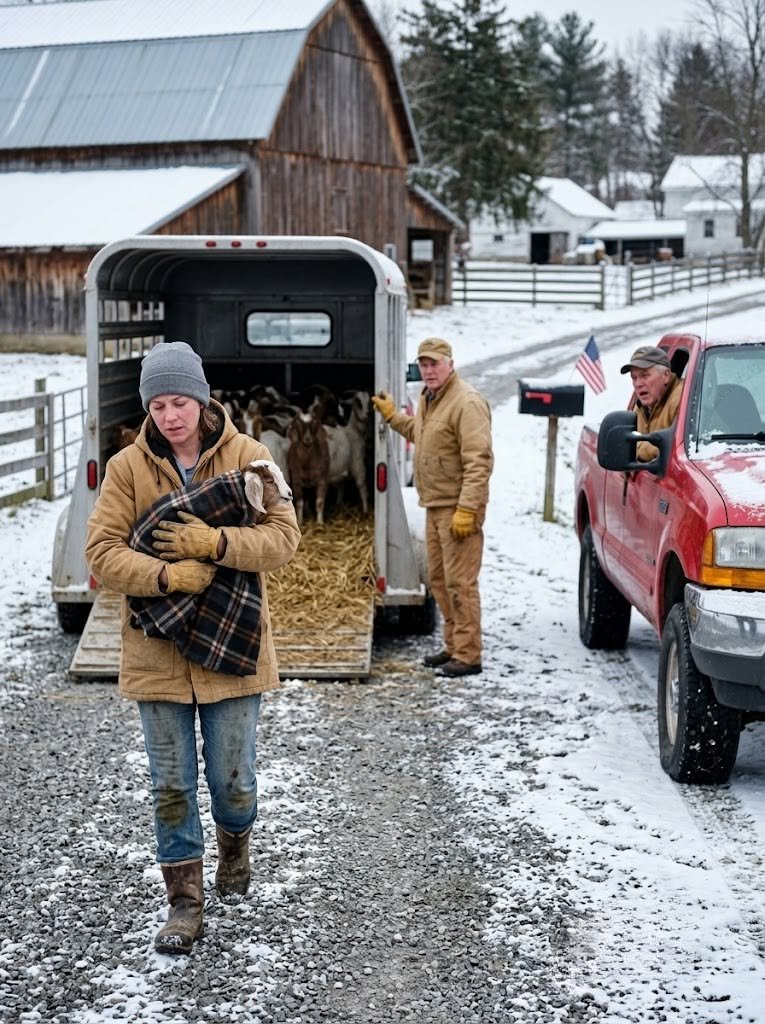
The trailer reached Hart Farm just after sunrise, rattling down the county road with 200 goats inside and a complaint rising from every slat. The morning was cold enough to turn breath white. The old south barn stood open. Miriam Hart stood at the gate, gloved hands in her pockets, as if she had been waiting not for a delivery but for a verdict.
She had been awake since five. Not because the animals needed her yet. They were not technically hers until the trailer backed into place. But Miriam had learned from farming that arriving early was one of the few ways a person could show respect for trouble.
Bud Colter stopped his truck on the road shoulder to watch. Bud farmed the acres east of hers, and he had the steady suspicious patience of a man who believed most surprises were poorly planned expenses. When the trailer door dropped and the first wave of goats stumbled into view, his eyebrows rose.
“What in the world are you going to do with 200 goats?”
Miriam looked at the thin bodies, rough coats, awkward legs, and three newborn kids blinking in the straw where they had been born during the ride. “I’m not entirely sure yet.”
Bud’s face did what people do when they want history to remember they objected early. “You bought 200 goats without a plan.”
“I bought 200 goats,” she said, “and I’m working on the plan.”
That was not as reckless as it sounded.
Miriam had not bought them because they looked good. They did not. At the Adams County sale, most buyers had seen poor condition, foot problems, late pregnancies, and a year of bad management written all over the herd. Miriam saw those things too. She also saw bone, frame, eyes, and a kind of hidden soundness underneath the neglect.
She had taught high school biology for 12 years before coming home to the farm after her father’s death. She knew the difference between damage and nature. These goats were not useless. They were tired.
So she bid.
For two weeks, Hart Farm became a triage station. Miriam worked through the herd with a notebook, a hoof knife, feed, straw, water, patience, and help from Carol Strand, the large-animal vet who had known her father. Carol examined the worst of them, treated what needed treating, and stood back after four hours with her hands on her hips.
“These are better animals than they look.”
“I know,” Miriam said.
Advertisements
“You knew that when you bought them.”
“I thought I knew it. Now I’m more sure.”
Carol asked the same question Bud had asked. What was Miriam going to do with 200 goats?
“Right now, get them healthy,” Miriam said. “After that, watch them.”
Carol knew the Hart family well enough to hear Thomas Hart in that answer. Miriam’s father had believed animals were not just mouths to feed or units to count. He believed they were observers with noses, hooves, instincts, habits, and old knowledge people often dismissed because it did not arrive in sentences.
If you did not know what an animal was telling you, Thomas used to say, you probably were not listening at the right time.
In March, Miriam opened the northeast corner.
Every farm has a place the family explains away. Hart Farm’s place was 40 acres of limestone outcrop, cedar scrub, old draws, and thin soil. Her grandfather had called it the rock pile. Her father had called it the rock pile. The county assessor called it marginal pasture, which was the government’s quieter way of saying the same thing.
Miriam thought goats might do well there. They could browse cedar and brush. They could travel slopes cattle ignored. They could make the useless corner useful, even if only by cleaning it enough that Miriam could see it.
The goats did not hesitate.
They moved through the gate with the strange confidence animals sometimes show in a new place, as if the land had already spoken to them from the other side of the fence. Younger goats scattered into brush. A few climbed the lower shelves. But the older does moved to the northwest face of the limestone.
One of them had a split ear. Miriam had noticed her from the beginning because old animals in any herd carry a map the younger ones borrow. The split-eared doe walked straight to the base of the rock, lowered her head, and pressed her nose to the limestone.
She did not eat.
She smelled.
Miriam wrote it down.
The next day, the doe did it again. The day after that, six older does gathered along the same wall, returning to the same strip of ground where the limestone met the soil. Miriam watched them for 90 minutes. Browsing goats do not stand still like that. Curious goats move, taste, test, and leave. These goats were not feeding. They were investigating.
On the fourth day, Miriam crouched beside the split-eared doe and put her palm against the ground.
The rock was cold. That made sense. It was March. Limestone holds winter.
The soil at the base was different.
Not just colder.
Steadier.
There was a stable coolness there that did not belong to surface weather. Miriam had spent enough years teaching biology to know steady temperature usually meant a system was being regulated by something bigger than the air. Shade could do it. Rock mass could do it. Moving water underground could do it too.
She refused to decide too soon.
Instead, she went inside and opened her father’s journals.
Thomas Hart had kept 32 notebooks, one season folding into the next. They recorded planting dates, rainfall, repairs, calf trouble, seed decisions, weather, questions, failures, and observations that would have sounded small to anyone who did not understand farms. Miriam had read some of them after she returned home. She had avoided others because grief sometimes hides in ordinary handwriting more sharply than in photographs.
She chose 1971 because it had been a drought year.
In July, she found it.
Cattle have been going to the northeast corner every afternoon, her father had written. Not grazing. Standing at the base of the big limestone shelf, northwest face. Soil at the base too cool for July. Might be nothing.
A week later, another note.
Dad says his father mentioned a spring somewhere in that corner. Old stonework, maybe covered over.
Then the line that made Miriam sit back.
I don’t have time to investigate this summer, but I’m writing it down.
He had written it down for someone. He could not have known that someone would be his daughter, 55 years later, sitting at the same kitchen table with goat dust on her jeans.
The next morning, Miriam took a piece of bent rebar to the rock face. Most places stopped the probe quickly. Four inches. Five inches. Rock. That was the old story of the corner. Soil too thin. Nothing to work with.
Then the bar slipped.
It hit stone, slid along an unseen edge, and dropped another two inches into a space that did not feel like solid limestone. Miriam tried again. Same answer. A faint hollow note traveled up the metal.
She called the county extension office.
Dave Coller listened to the whole story without interrupting: the goats, the cold soil, the 1971 journal, the rebar, the old family mention of a spring. When she finished, he gave her one name.
Warren Fitch.
Warren was 67 and had spent decades documenting old farm wells, limestone spring chambers, cisterns, and hand-built water systems across southeast Nebraska. He arrived on a Saturday with a canvas bag, a worn hat, and the expression of a man who trusted old stone more than quick opinions.
He stood at the fence for a long while.
“German homesteaders?” he asked when Miriam told him the Brower family had owned the place before the Harts.
“Yes. Homestead claim in 1886.”
Warren nodded. German settlers in that county, he told her, were practical about water. If there was a limestone seep, they often built around it. Not fancy. Not decorative. Built to last.
Miriam showed him the spot.
Warren pressed one probe into the soil, then another. He found the same edge. He leaned close, one hand lifted slightly, asking for quiet.
At first, Miriam heard only wind through cedar.
Then she heard it.
Not a splash. Not a stream.
A vibration through steel.
Water.
They did not bring in machinery. Warren said machinery would either crush what they were looking for or miss it completely. Old stonework had to be approached the way it had been made, one layer at a time, with the patience to read each piece before moving the next.
Over three Saturdays, Miriam worked beside Warren and a young helper named Pete. They cleared soil, brush roots, and packed debris. The split-eared doe stayed near the fence whenever the herd rotated through, watching them with the settled interest of an animal waiting for people to finish a simple task very slowly.
The first Saturday, they found fitted limestone.
Not a natural slab.
A course of stones placed by human hands.
Warren brushed dirt from a joint and smiled without showing his teeth. “Late 19th century. Whoever did this knew what they were doing.”
The second Saturday, they opened the chamber.
It was roughly eight feet square, dry-laid limestone, the walls corbeled inward with a skill that had survived decades underground. The floor was wet. Along the north wall, water seeped from a crack in the limestone and moved across the chamber floor toward an old overflow channel on the east side.
The chamber had been buried.
It had not been dead.
Warren crouched with his light shining into the opening. “This is a functioning spring chamber,” he said. “Nobody has been using it, but it has been working since the day it was built.”
Miriam looked at the dark water moving quietly over stone. She thought of the goats pressing their noses to that wall. She thought of cattle in 1971 standing there through a dry July. She thought of her father feeling the cool soil through his boots and writing down a question he could not chase.
The goats did not save the farm. They reminded it.
Water tests came back clean. Limestone aquifer water, high in minerals, safe for livestock, steady enough to matter. It would not replace the household well, but it would water the northeast pasture in dry weather. For land that had been dismissed as a rock pile, that was no small thing.
Warren returned to clear the overflow channel. When the last packed obstruction came loose, water ran along the old stone path and disappeared into the ground where it had once been meant to go. The design was simple and exact: collect the seep, prevent flooding, direct the excess, keep the source reliable.
“Someone built for permanence,” Warren said.
By May, Bud Colter slowed his truck again.
This time he was not watching a mistake arrive. He was looking at goats moving through opened brush, cedar lower limbs cleared, old draws visible, and a low trough filling from a line Miriam had run from the chamber. The split-eared doe stood near the cover Warren had fitted over the access point, calm as a foreman after inspection.
“What’s that structure?” Bud asked.
“Spring chamber,” Miriam said. “Probably 1890s. The Brower family built it to collect a natural spring from the aquifer.”
Bud stared. “There’s a spring in your rock pile.”
“There has been since before my grandfather bought the land. We just didn’t know where it was.”
“How did you find it?”
Miriam looked toward the old doe. “The goats showed me.”
Bud was quiet for a long time. “I’ve been farming next to this corner for 16 years.”
“I know.”
“I always thought it was just rock.”
“It looked that way.”
That summer, when the creek in the south pasture dropped and water hauling would normally have begun, Miriam did not haul water for the northeast section. The chamber filled the trough steadily enough for the rotation. The goats that had arrived ribby and rough now moved with sleek confidence through land they had helped her read.
She sold part of the herd in the fall, enough to cover the purchase, vet care, and winter feed. She kept a core group.
She kept the split-eared doe.
On paper, the old doe probably did not make sense. She was past her best production years. There were younger, stronger animals with cleaner economic arguments for staying. But ledgers have limits. Miriam had no column for an animal that turned a forgotten corner into water.
So she left that out of the ledger.
She wrote it in the notebook instead.
In June, at Warren’s suggestion, Miriam registered the spring chamber with the county historical preservation office. A woman came out to measure it, photograph it, and write the discovery into the county record. The chamber would not depend on family memory again. It would have a file. A map. A description. A place where the next person could find it.
That mattered to Miriam more than she expected.
One October evening, she walked the northeast corner alone. The light stretched amber across the flat fields. The goats moved through the scrub in patterns she had learned to read. The spring ran into the trough with the same quiet persistence it must have had before the Harts, before her father, before her.
Miriam thought about Thomas in 1971, too busy to investigate and too careful not to record the question. She thought about the Brower family, building stone around water because survival demanded practical faith. She thought about the split-eared doe, nose to limestone, saying nothing and being right anyway.
The land had not kept the secret out of cruelty.
People had simply stopped asking the right question.
That night, Miriam fed the herd, checked the water, latched the gate, and went inside. She opened her own notebook and wrote the update plainly: northeast corner active pasture, spring chamber producing reliably, water test on file, split-ear doe healthy.
Then she closed the notebook and placed it beside her father’s journals.
For whoever came next.