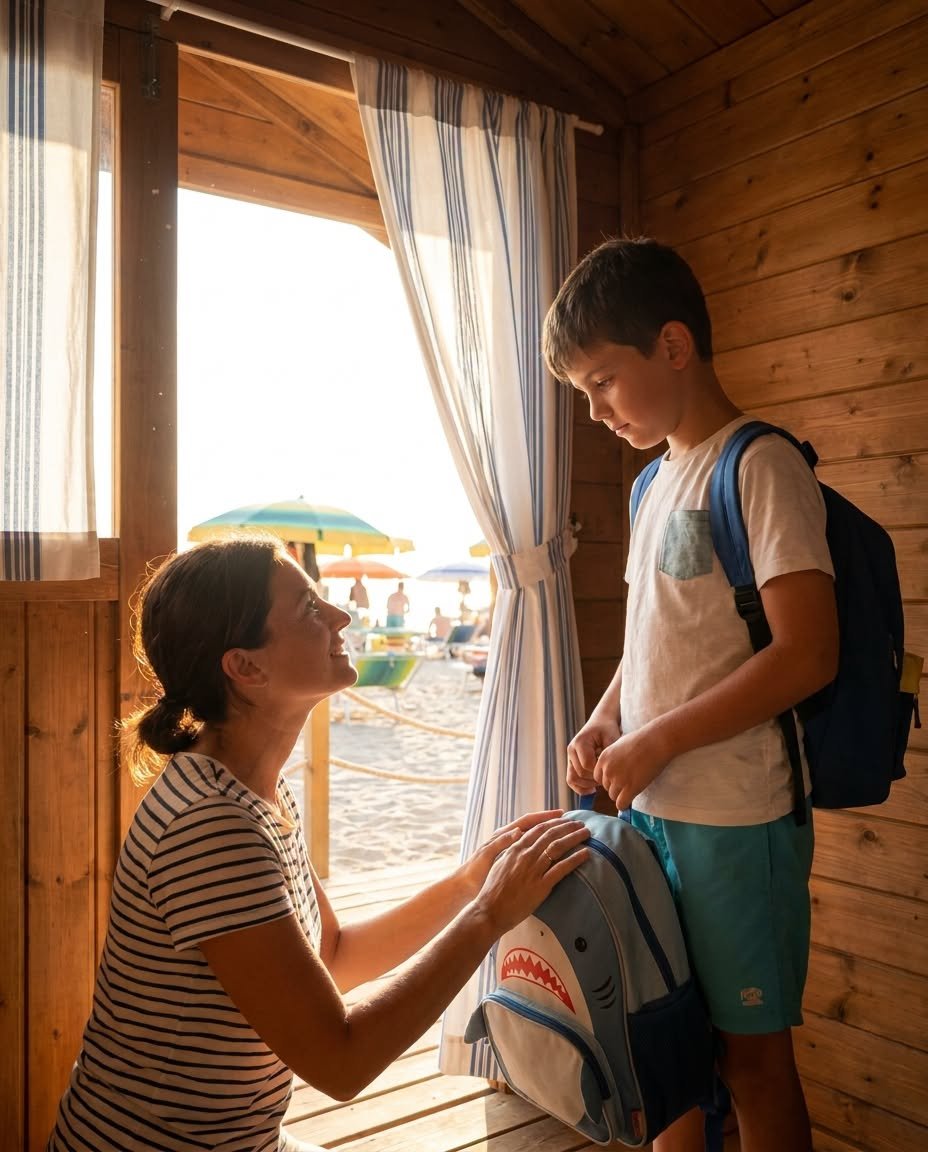
Taylor froze with one hand lifted toward the striped curtain, her bare feet sinking into warm sand outside the beach changing cubicle. Through the narrow gap, she could see her six-year-old son Nathan’s blue sandals, and at first that was enough to calm her. Then she heard Cheryl, her mother-in-law, whisper, “Now tell Grandma what we agreed.” Nathan answered in the careful voice of a child reciting a rule: “Mommy can never know what you gave me.” The sound of gulls and children playing seemed to fall away, leaving only the rustle of the curtain and the thud of Taylor’s own heartbeat. She yanked the fabric aside and found Cheryl kneeling in front of Nathan, one hand near the zipper of his shark backpack. Inside was a tiny glass bottle tied with blue ribbon, filled with beach sand and rolled paper notes, and for one terrifying second Taylor thought the woman she trusted most had been teaching her son to hide something dangerous.
For six years, Cheryl had been the grandmother other mothers envied: careful, present, pancake-making, birthday-remembering, the kind of woman who washed grapes before anyone asked and knitted sweaters for a Texas child who barely needed one. Every summer, Will’s parents rented the same little blue beach house on the Gulf Coast, where towels draped over porch railings, the kitchen smelled of lemon soap and fried shrimp, and the cousins spent long afternoons building crooked castles in wet sand. Nathan adored Cheryl without hesitation, and Taylor had always taken comfort in that bond. That Saturday had begun like every other beach day — sunscreen, chips crushed into towels, the cousins shouting about “shell security” around their castle — until Nathan disappeared for ten minutes and Taylor found his sandals beneath the changing-room curtain. Cheryl’s secretive words turned a harmless search into something colder, sharper, and impossible to ignore.
Back at the beach house, after Nathan finally fell asleep, Taylor placed the bottle on the kitchen table between herself, Will, and Cheryl. The older woman looked smaller under the single lamp, her hands moving nervously over an old folded note she pulled from her cardigan pocket. She explained that the tradition had begun after her own mother died, when she realized grief had not stolen the big memories first, but the ordinary ones: the tune her mother hummed while watering flowers, the way she burned the first pancake, whether she tucked her hair behind her ear before reading or after. Every summer, Cheryl had written down small family moments and tucked them into the bottle so Nathan would one day have a record of the things life never warns you it is about to take. When Taylor opened the first notes, she found not secrets, but fragments of love: her own childhood fear of waves, Will’s nervous whistle, Nathan crying over a crab with one claw, and Taylor’s habit of saving broken shells because “somebody should still love them.” What had looked like betrayal slowly revealed itself as a fragile archive of ordinary days.
The problem, Cheryl admitted, was not the bottle but the language. She had meant it as a surprise for Taylor someday, but Nathan, being six, had turned “Mommy can’t know yet” into a solemn secret. Taylor, still shaken, told Cheryl that children needed clear boundaries around secrecy, trust, and emotional safety, especially when adults they adored were involved. Cheryl accepted it without defending herself, and Will backed Taylor firmly, agreeing that no tradition, however tender, should ask a child to carry confusion alone. The next morning, as the beach house emptied and coolers snapped shut, Cheryl handed Nathan a blank strip of paper and a tiny pencil. He sat on the porch step, tongue peeking from the corner of his mouth, and wrote his own memory before rolling it carefully into the bottle. No one asked what it said, because for the first time Taylor understood that preserving a moment did not mean owning it.
Halfway home, Nathan slept in the back seat with his shark backpack beside him, sunburned cheeks soft against his stuffed whale. At a red light, Taylor gently opened the bottle and unrolled the newest note. In uneven six-year-old handwriting, Nathan had written, “Grandma cries when she smiles really big.” In the front passenger seat, Cheryl was laughing with Will about the turn he missed every summer, unaware that her grandson had noticed the very tenderness she thought she was quietly giving away. Taylor rolled the paper back up and slipped it carefully inside the bottle. She still believed some secrets were too heavy for children, but she also understood now that some traditions were not meant for shelves or speeches or perfect family photographs. They were meant to be carried through ordinary days, before anyone realized those were the memories they would one day ache to hold.