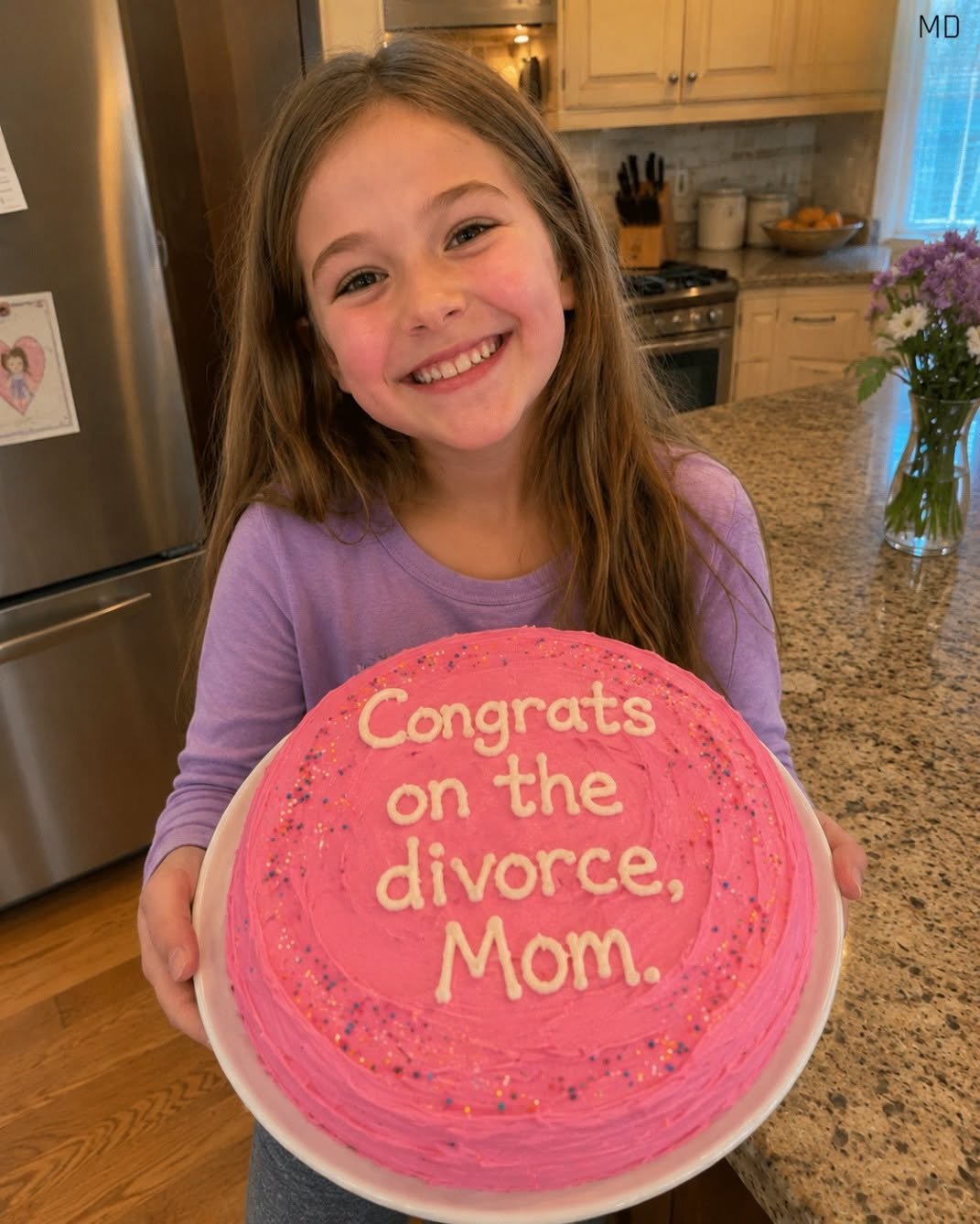
My Daughter Baked Me a “Divorce Cake” — Then I Found a Key Hidden Inside
I knew something was wrong the moment my 11-year-old daughter, Gracie, proudly placed a crooked chocolate cake on the kitchen counter. Pink frosting spelled out, “CONGRATS ON THE DIVORCE, MOM,” even though I had never discussed divorce with her—or with my husband, Caleb. When I asked what she meant, she casually said Dad had told her we were finally separating. After 13 years of marriage, Caleb and I had problems, but no papers had been filed and no decision had been made. Gracie seemed almost relieved, saying maybe I would stop apologizing, stop crying in the laundry room, and stop disappearing upstairs whenever Caleb’s friends visited. I tried to steady myself and cut the cake. That was when the knife struck something hard.
Hidden inside the lower layer was a plastic bag containing a brass key marked 214. Gracie admitted she had found it in Caleb’s office after hearing him tell a friend, “Once she signs, she won’t know what’s missing.” That night, I checked our financial records and discovered unexplained transfers of $4,000, $6,500, and $9,000 to Westfield Storage. Caleb denied planning a divorce, but during our phone call I heard another woman beside him before he abruptly hung up. The next morning, I found a storage receipt bearing his name and the same number printed on the key: Unit 214. I was ready to open it myself—until one phone call changed everything.
My sister connected me with a divorce attorney, who warned me not to touch the unit and instead document every record I could legally access. Behind old files in Caleb’s desk, I found a draft divorce petition claiming we had already been separated for four months, along with paperwork portraying me as financially reckless. Worse, nearly $38,000 had been transferred from an investment account I inherited from my father using a signature I did not recognize as mine. My attorney traced the money, reviewed our insurance and mortgage records, and demanded disclosure through the court. Once Unit 214 became part of the case, its contents were documented: cash, electronics, financial files, missing jewelry from my grandmother’s estate, and boxes Gracie had seen Caleb remove from his office. Records showed he had been shifting assets while building a paper trail designed to make me appear irresponsible. The woman I had heard on the phone was not a romantic partner, but a financial adviser involved in several transfers. Caleb had not simply been preparing to leave—he had been preparing the financial story he wanted everyone else to believe.
Months later, the divorce was completed, and the assets Caleb had tried to move still had to be accounted for. He walked away with far less control than he expected, while I learned every account, payment, investment, and document carrying my name. More important, Gracie slowly stopped watching my face whenever someone raised their voice. Six months after that first cake, she banned me from the kitchen again. This time, she presented a lopsided cake covered in blue frosting and yellow flowers with the words, “WELCOME HOME, MOM.” I laughed and reminded her we had never moved. Gracie looked at me and quietly replied, “I know. But you’re here now.” That was when I finally understood: the first cake had never been about celebrating the end of our family. My daughter had been celebrating the possibility of getting her mother back.