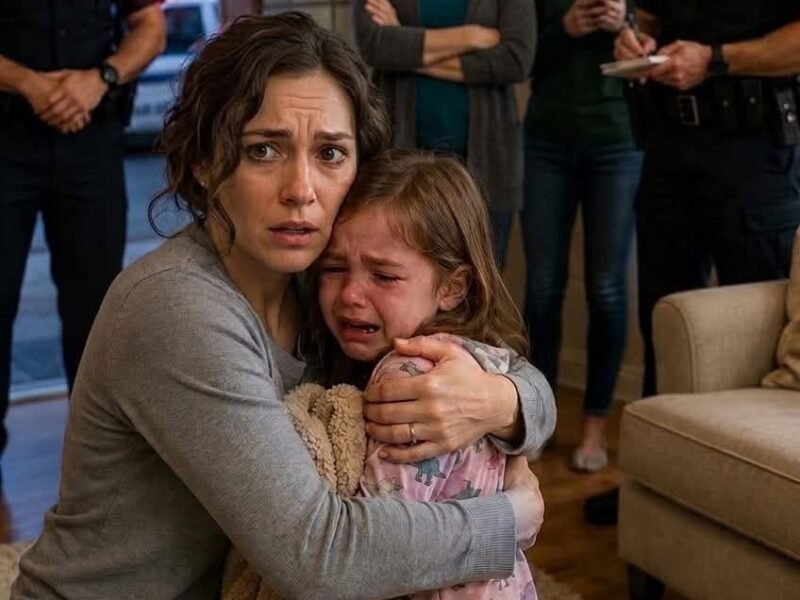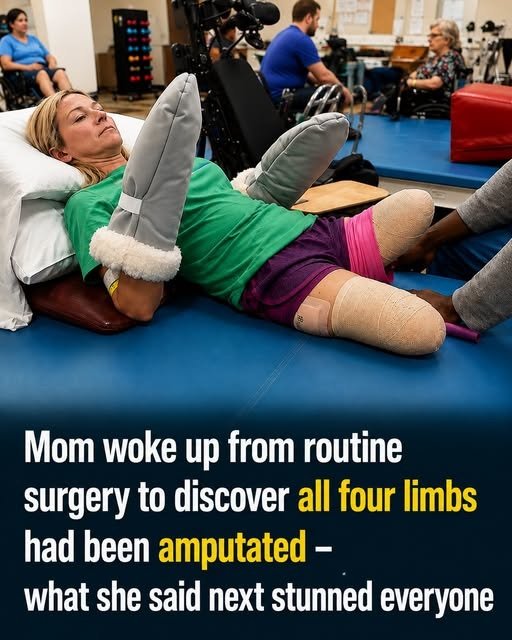
What began as treatment for kidney stones in December 2023 turned into a life-changing medical emergency for Kentucky mother Lucinda “Cindy” Mullins. Mullins had been dealing with kidney stones and underwent treatment, including a procedure in which a temporary stent was placed. Soon afterward, her health deteriorated rapidly when an infection led to sepsis and then septic shock, a dangerous condition in which the body’s response to infection can threaten vital organs.
Her husband, DJ, found her seriously ill at home and helped get her to medical care. She was initially treated at a hospital in Stanford, Kentucky, before being transferred to the University of Kentucky Hospital in Lexington. What followed was a lengthy fight to keep her alive. Mullins spent days heavily sedated as doctors worked to stabilize her condition and protect her vital organs. According to reporting by The Washington Post, she required intensive treatment while doctors tried to restore circulation to her extremities, including an unsuccessful fasciotomy intended to relieve pressure and improve blood flow.
The treatments succeeded in helping protect essential organs, but the crisis had already caused catastrophic damage elsewhere. Tissue in portions of her arms and legs had died because of severely compromised circulation. Doctors eventually faced an extraordinarily difficult conclusion: amputations would be necessary for Mullins to survive and recover. It was not the outcome she or her family had expected when the medical ordeal began.
On December 18, 2023, Mullins asked one of her doctors to explain her condition directly rather than soften the news. She later recalled being told that doctors would have to remove her legs. On December 19, she underwent surgery and woke several hours later without both legs below the knees. Doctors also determined that portions of both arms would need to be amputated below the elbows because of the extensive tissue damage. Contrary to some simplified versions of the story circulated online, she did not simply enter a routine operation and awaken moments later with all four limbs gone.
Her amputations came after a severe episode of sepsis and days of intensive medical treatment aimed first at saving her life. The medical reality was enormous, but Mullins repeatedly emphasized something else when she began speaking publicly about the experience: she was alive. She told reporters that she was grateful for another opportunity to see her husband, her children, relatives and friends. Rather than focusing solely on everything the infection had taken from her, she spoke about what remained.
Her family was still around her, she had survived a condition that could have killed her, and she had a future she wanted to pursue. That outlook became one of the themes of the interviews she gave in the months after her illness. Mullins also spoke openly about the role her Christian faith played in the way she processed what had happened.
She said she felt a sense of peace when doctors explained why the amputations were necessary and believed there was still a purpose for her life. Her statements were descriptions of her own religious belief rather than medical explanations for her recovery. She acknowledged that difficult days would inevitably come, but she repeatedly returned to her gratitude for being alive and able to remain with her family. That combination of realism and optimism shaped much of the public attention surrounding her recovery.
Her family also became an important part of the recovery process. Mullins is married to DJ Mullins, and they have two sons. In the early period after her amputations, everyday activities that she previously performed independently suddenly required help from other people. Reporting at the time described her husband helping her move and eat while she recovered in the hospital. Her twin sister, Luci, also assisted with personal care, and her children found their own ways to help their mother. Those moments reflected the practical reality of adapting to major limb loss while the family was still processing how abruptly their lives had changed.
Before the medical emergency, Mullins had built a career in health care, working for years at a local family medical practice. She later said she wanted to return to work rather than allow the amputations to end that part of her life. Reporting in early 2024 identified her workplace as Bates, Miller & Sims and described her as a certified medical assistant who had worked there for approximately seventeen years. Her goal of returning was not presented as an easy or immediate promise. Instead, it illustrated her determination to regain as much independence and normality as possible as rehabilitation progressed.
Rehabilitation required learning new ways to perform tasks that most people rarely have to think about. Mobility, eating, personal care and countless ordinary movements suddenly involved new techniques, assistance or adaptive equipment. Mullins spent time at Cardinal Hill Rehabilitation Hospital in Lexington as she worked toward greater independence. One major milestone arrived in 2024 when she began walking using prosthetic legs. Video shared publicly showed her taking steps with the help of a walker, representing months of recovery after the medical crisis that had changed her body so dramatically.
Her progress with prosthetics also highlighted a broader challenge faced by many amputees: prosthetic devices can serve different functions, and insurance coverage does not always provide access to every device that could improve a person’s independence. Mullins eventually became involved in efforts to improve prosthetic insurance coverage in Kentucky. That effort moved beyond her personal rehabilitation and into public policy, but her involvement can be described without portraying her as a political voice speaking for every Kentuckian. Her own experience simply gave her a firsthand understanding of how important access to appropriate prosthetic technology can be for someone adjusting to limb loss.
In 2026, Kentucky lawmakers considered Senate Bill 97, legislation addressing insurance coverage for prostheses and orthoses. The measure established requirements for certain health-benefit plans to provide such coverage and included provisions concerning utilization review, denial notices, provider networks and other insurance practices. The Kentucky General Assembly’s official record shows that the legislation passed, and Governor Andy Beshear signed it on April 7, 2026. The legislation is scheduled to affect applicable health plans beginning in 2027. Those details come from the state’s official legislative record rather than from claims circulating on social media.
For Mullins, the issue had a very personal meaning. Losing four limbs meant that prosthetic technology would become part of her everyday life rather than an abstract health-care issue. Different prosthetic devices can be useful for different activities, and access to more than one appropriate device can affect mobility and independence. Mullins publicly celebrated progress surrounding the legislation and thanked people who supported the effort. Still, it is more accurate to say that she was involved in advocating for improved prosthetic coverage rather than claiming that she alone “passed” Senate Bill 97. The bill itself had multiple legislative sponsors and was ultimately approved through Kentucky’s legislative process before being signed by the governor.
Her story also attracted extensive community support from people who wanted to help the family adapt to a radically different daily reality. Friends, relatives and supporters organized fundraising assistance after her hospitalization. Early reporting documented more than $100,000 being raised to help with expenses related to her recovery and future prosthetics. The support became another part of the family’s adjustment, particularly because accessibility changes, medical care, rehabilitation and specialized equipment can create significant practical needs after multiple amputations. Mullins repeatedly expressed gratitude toward the people who supported her and her family during the ordeal.
As her recovery continued, Mullins shared milestones rather than presenting rehabilitation as a simple transformation. Learning to walk with prosthetic legs, adapting to new devices and relearning everyday activities involved repeated practice. Public videos of her walking were widely shared because they showed visible progress, but those moments represented only a small portion of the rehabilitation happening away from cameras. Becoming more independent after four amputations is not a single achievement reached in one day. It is an ongoing process involving physical rehabilitation, prosthetic fitting, family assistance and adjustment to changing needs.
Her children also remained central to how Mullins described her motivation. From the earliest interviews, she emphasized that surviving meant she could continue being present for her sons and her husband. Her family did not erase the seriousness of what had happened, but it gave her a reason to focus on the future rather than exclusively on what she had lost. She openly acknowledged that there would be difficult periods ahead. At the same time, she consistently described survival itself as something worth celebrating. That attitude is why she resisted portraying her experience only as a tragedy.
More than two years after the original medical crisis, Mullins’s life continued to involve new challenges rather than a perfectly completed recovery story. Local reporting in February 2026 revisited her experience and described the difficulties she was still navigating. That is an important part of presenting her story accurately. Recovery from a catastrophic illness and four amputations does not become effortless simply because someone maintains a positive attitude. Her optimism exists alongside the physical, practical and emotional demands of adapting to life with prosthetic devices and significant mobility changes.
The medical episode itself also offers an important reason to describe the story carefully. Sepsis is a serious medical emergency caused by the body’s extreme response to infection, and Mullins’s case involved an infected kidney stone followed by septic shock. Her outcome was unusually severe and should not be interpreted to mean that kidney-stone procedures normally lead to amputations. In her case, the combination of infection, shock, impaired circulation and the measures necessary to keep her vital organs functioning resulted in devastating tissue damage to her extremities. The amputations were undertaken after doctors concluded the affected tissue could not be saved.
That distinction matters because dramatic headlines can sometimes make a complicated medical event sound instantaneous. Mullins did not simply undergo an ordinary operation that directly removed four healthy limbs without warning. She became critically ill from infection, developed septic shock, underwent intensive treatment, and survived a medical emergency that threatened her life. Only afterward did the full extent of the damage to her limbs become clear. Presenting that sequence accurately preserves the seriousness of what happened without turning a real person’s medical crisis into an exaggerated story.
Mullins herself has consistently chosen to emphasize survival rather than anger. That does not mean the loss of her limbs was insignificant or easy to accept. It means that when she spoke publicly, she repeatedly returned to the fact that the treatment allowed her to remain with the people she loved. She described being grateful that doctors saved her life and said that knowing she could see her family again gave her peace. Her faith, family relationships and determination to regain independence became central themes in the way she talked about what happened.
Her journey since December 2023 has therefore involved much more than the dramatic fact that she became a quadruple amputee. It has included surviving septic shock, enduring multiple surgeries, undergoing rehabilitation, learning to use prosthetic devices, returning to ordinary family routines and becoming involved in efforts related to prosthetic insurance coverage. Each milestone has required adaptation to circumstances she could not have expected before becoming ill. The attention surrounding her story has also given her an opportunity to speak publicly about resilience and the importance she places on family, faith and independence.
Perhaps the most accurate way to understand Lucinda Mullins’s story is not as a tale in which everything suddenly became easy because she remained optimistic. Her situation was medically devastating, and her recovery has required extensive treatment and adjustment. What distinguished many of her public comments was her decision not to define survival solely by what she had lost. She repeatedly focused instead on still being able to see her husband, raise her children and continue building a future. That perspective came from Mullins herself and has remained consistent across interviews since the earliest weeks of her recovery.
Today, her story remains one of survival followed by continuing adaptation. The infection that began the crisis permanently changed her body, but it did not end her role as a wife, mother or member of her community. She has reached rehabilitation milestones that once seemed distant, including walking with prosthetic legs, while also lending her experience to discussions about access to prosthetic care. Senate Bill 97’s passage in Kentucky in 2026 became another documented chapter in that broader story.
Mullins has never suggested that losing four limbs was something anyone would choose. What she has said, repeatedly, is that surviving gave her something more important to concentrate on: additional time with the people she loves. Her experience began with a medical emergency that few families could have anticipated and resulted in permanent changes that she will navigate for the rest of her life. Yet the message she chose to share publicly was not that her story ended in December 2023. For her, surviving the crisis meant that another part of the story was only beginning.