THE GROUND BENEATH HARRINGTON PEAK
My father laughed before he finished the sentence.
“We don’t need your pocket change, Claire.”
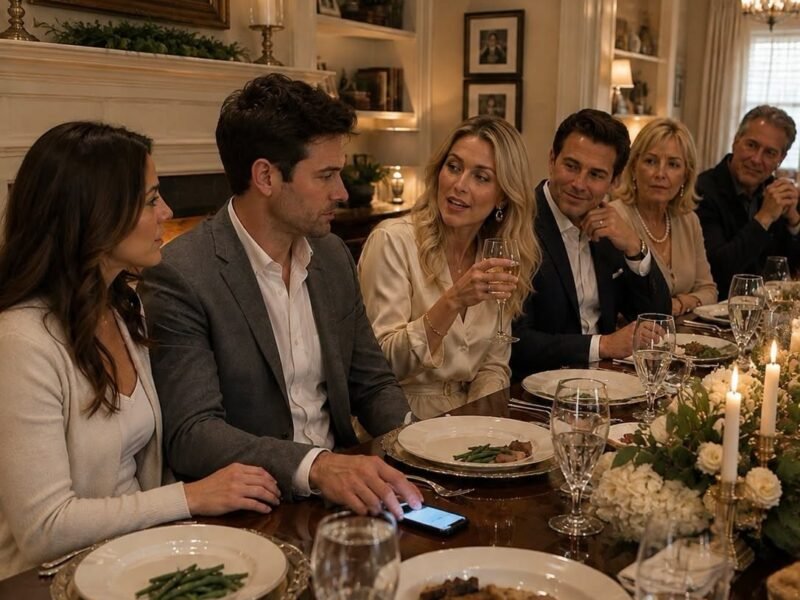
The dining room at Harrington Peak Resort went quiet just long enough for everyone to hear him clearly, then several people around the table smiled as if he had delivered a charming family joke. Outside the wall of windows, fresh snow covered the lower slopes of the Colorado mountains. Inside, a fire burned beneath a stone mantel, wineglasses reflected the chandelier light, and a framed opening-day photograph of our family hung directly behind my father’s chair.
I had almost been removed from that photograph.
Only the edge of my left arm remained in the version hanging on the wall.
Dad tapped the valuation report lying beside his plate. “You’re offering us two hundred fifty thousand dollars like you’re rescuing some roadside motel. This resort is worth fifty million.”
My older brother Grant leaned back in his chair, satisfied. My younger sister Natalie gave me the same polished smile she used in promotional photographs. Mom stared down at her dinner.
Natalie lifted her wineglass. “Maybe Claire’s little property job finally paid a bonus.”
Grant laughed.
I didn’t.
I was thirty-four years old, and I had spent enough of my life trying to make my family understand me.
That night, I stopped.
I reached beneath the table, unlocked my phone, and opened the secure management portal for Juniper Ridge Land LLC.
One message.
Elena Ruiz, my property manager, was waiting for instructions.
I typed:
Decline renewal proposal. Proceed under existing lease terms through expiration. No holdover extension.
I read it twice.
Then I pressed Send.
There was no dramatic satisfaction.
My hand actually trembled.
I placed the phone beside my untouched plate.
Dad was still talking.
“You built a respectable little consulting career, Claire. That’s fine. But there’s a difference between analyzing properties and operating one of the most successful independent mountain resorts in Colorado.”
“Apparently,” I said.
He mistook the answer for surrender.
That had happened often in our family.
My quiet was usually interpreted as agreement.
Grant leaned toward me. “You know what your problem is? You always wanted the title before doing the work.”
I looked at him.
Grant had become chief operating officer of Harrington Peak without ever working anywhere outside the family company.
I said nothing.
Ten minutes later, the private dining-room doors opened.
Daniel Cho, the resort’s chief financial officer, came in without his jacket. His laptop was pressed against his chest, and the expression on his face wiped every trace of amusement from the room.
“Richard.”
Dad frowned.
“What is it?”
“We need the board.”
“Now?”
“Yes.”
Daniel looked at Grant.
“Immediately.”
Grant rolled his eyes. “Can this wait until after dinner?”
“No.”
Daniel opened the laptop on the sideboard.
“The ground lease expires in eleven days. Juniper Ridge sent formal notice at 6:12 tonight. No renewal. No temporary extension.”
My mother’s hand stopped halfway toward her water glass.
Natalie whispered, “What?”
Dad stood so quickly his chair scraped backward.
“That’s impossible.”
Daniel turned the screen toward him.
“It’s not.”
Grant pushed away from the table. “We have renewal rights.”
“We had a right to begin formal negotiation if we opened discussions one hundred eighty days before expiration.”
“We did.”
Daniel looked directly at him.
“No. Legal sent three reminders. Operations did not authorize a proposal until last month.”
Grant’s face tightened.
“You told me it was administrative.”
Daniel’s voice remained calm.
“I told you it was urgent.”
Dad turned toward Grant.
“You told me legal said this was routine.”
“It should have been.”
“That is not what I asked.”
For the first time that evening, nobody was looking at me.
I sat quietly beneath a photograph that had been cropped to suggest I was never part of the family’s success.
Then the first outside call arrived.
The bank wanted proof that Harrington Peak would retain lawful site control before releasing the next construction draw for the new spa wing.
Without a renewed lease, the draw would be paused.
Then the insurance broker called.
Several major policies were approaching renewal. The carrier wanted confirmation that the resort had an enforceable right to occupy the parcel supporting the lodge, spa, conference center, staff housing, and lower-slope facilities.
Natalie laughed once, too brightly.
“So we buy the land. Problem solved.”
Daniel looked at her.
“How much could forty-two acres possibly be compared with a fifty-million-dollar resort?”
She sounded confident again.
Daniel took a breath.
“The resort is valued as an operating business with long-term land access.”
“So?”
“Without land control, the improvements sit on property we don’t own.”
Dad’s face changed.
Daniel scrolled.
“There’s another issue.”
“What?”
“The original lease contains a reversion provision for certain permanent improvements if no replacement agreement is executed.”
Mom whispered, “What does that mean?”
Daniel hesitated.
“The buildings don’t disappear. But the company’s rights to occupy and operate them become extremely complicated, and several improvements may revert to the landowner subject to the lease terms.”
“The lodge?”
“Yes.”
“The residence?”
“Yes.”
Mom gripped the table.
She and Dad had lived in the private resort residence for twenty-nine years.
Natalie’s confidence vanished.
“What about weddings already booked?”
Daniel said, “Current events require legal review. New commitments may need to pause until site control is resolved.”
Grant started pacing.
“This is ridiculous.”
Dad pointed toward the laptop.
“Call the owner.”
Daniel swallowed.
“We’ve been communicating through their property manager.”
“Then call the property manager.”
“We have.”
“And?”
“She confirmed the decision.”
Dad’s voice hardened.
“Who owns the land?”
Nobody answered.
He looked around the room.
“Who owns my mountain?”
My hand was still resting beside my bag.
Grant noticed.
His eyes narrowed.
“Why are you so calm?”
I looked at him.
“What?”
“You reached into your bag when Daniel started talking about the landowner.”
Dad turned toward me.
Something passed across his face.
Suspicion.
Then hope.
“Claire.”
I waited.
“Do you know the owner?”
I looked at the four people who had been laughing at me ten minutes earlier.
My father, Richard Harrington.
My mother, Evelyn.
My brother Grant.
My sister Natalie.
For years, I had imagined what it would feel like if they ever needed something only I could provide.
In every fantasy, I felt triumphant.
In reality, I felt tired.
“Call the board,” I said. “Put Peter on speaker.”
Peter Lang was the family company’s outside attorney.
Dad frowned.
“What does Peter have to do with your answer?”
“Everything.”
Grant gave a sharp laugh. “She’s enjoying this.”
“No.”
I looked toward the photograph on the wall.
“I’m making sure this conversation happens in a room where nobody can edit me out afterward.”
That silenced Mom.
Dad ordered Daniel to send an emergency board notice.
We moved from the dining room into the private boardroom overlooking the north slope.
The same photograph hung there.
Opening day at Harrington Peak.
Dad in front.
Mom beside him.
Grant holding a ceremonial ribbon.
Natalie sitting on Dad’s shoulders.
At the far edge, a narrow strip of my sweater.
The original photograph had included sixteen-year-old me holding a wooden scale model of the resort expansion I had spent an entire summer building with one of the architects.
Years later, Mom had cropped it for a marketing campaign.
“The composition is cleaner,” she told me.
I remember staring at the brochure and realizing I had been transformed into empty space.
My family had always been skilled at making exclusion look aesthetic.
The Harrington story, as told publicly, was simple.
Richard Harrington built a mountain resort from nothing.
His wife supported him.
His son Grant inherited his operational instincts.
His younger daughter Natalie inherited his charisma.
Then there was Claire.
The child who “went her own way.”
That was how they described me.
Never rejected.
Never overlooked.
I simply went my own way.
The truth was less convenient.
I had wanted Harrington Peak desperately.
At twenty-seven, after earning an MBA and spending several years working on distressed hotels and underperforming hospitality assets, I went to Dad with a twelve-page proposal.
I did not ask to become an executive.
I asked for a junior acquisitions role.
I had researched small properties Harrington Peak could potentially acquire or manage.
I had built financial models.
Market comparisons.
Renovation cases.
Debt assumptions.
Dad did not read past page two.
“You take things personally.”
I stared across his office.
“What does that have to do with acquisitions?”
“Everything. Hospitality is pressure.”
“I already work in hospitality finance.”
“Advisory.”
“Yes.”
“That’s different.”
“How?”
“You analyze after other people take the risk.”
I remember feeling heat move into my face.
“I’ve worked on restructurings with lenders, owners, and operators.”
Dad leaned back.
“Grant has the stomach for real operations.”
Grant had spent the previous four years inside the resort.
Two weeks later, Dad promoted him to chief operating officer.
I left Colorado.
Not dramatically.
No speech.
No family cutoff.
I went back to Denver and built my career.
Eventually, I co-founded a real estate analytics company with two colleagues. We developed software and advisory tools for hotels, senior housing, and mixed-use properties.
The first two years were terrible.
We lost a major client.
Our lender reduced our line.
One investor pulled out at exactly the wrong moment.
I called Dad once.
Not for a gift.
For a secured bridge loan against my equity.
He said no.
“Business has to survive on its own.”
So I sold my car.
Moved into a smaller apartment.
Slept in the office more than once.
Made payroll.
We survived.
Three years later, a hotel investment group bought the platform.
After taxes and obligations, my share left me with just under $1.4 million.
My parents knew the company sold.
They never asked what I made.
Mom sent:
Congratulations! Proud of you.
Dad called and said:
“Good learning experience.”
I laughed for twenty minutes after that call.
Then something happened that altered the rest of my life.
A former client sent me an auction packet.
The Caldwell Trust was liquidating a parcel outside Aspen.
Forty-two acres.
Mountain land.
Long-term commercial ground lease.
My family’s resort sat on top of it.
I knew Harrington Peak did not own every surrounding acre.
I had never understood that it did not own the land beneath its central operating campus.
Dad’s original company had leased the parcel decades earlier because buying land and building simultaneously would have required too much capital.
Over time, the story changed.
“We built this mountain.”
“We own the peak.”
Language became memory.
Memory became mythology.
Legally, Harrington Peak Resort Company owned substantial improvements.
The Caldwell Trust owned the ground.
The lease still had seven years remaining when the land came to market.
Large institutional funds disliked the parcel because of easements, reversion language, and the long remaining tenant term.
Several buyers wanted cleaner land.
I saw something different.
Predictable rent.
Irreplaceable location.
A tenant with no realistic substitute parcel.
Most importantly, I understood the tenant.
Better than the tenant understood itself.
I formed Juniper Ridge Land LLC.
Nothing secret or improper.
The company was registered normally, managed through professional counsel and a third-party property manager. Public records showed the registered agent and entity information as required, but my family never bothered asking who controlled it.
I invested nine hundred thousand dollars of my own money.
The Caldwell Trust financed part of the purchase through a secured seller note. A small private investment fund supplied additional capital in exchange for a temporary minority interest.
Purchase price: $5.6 million.
The sale closed.
Recorded properly.
Harrington Peak’s attorneys received notice.
Grant signed the tenant acknowledgment.
Nobody asked who ultimately controlled Juniper Ridge.
Rent kept going to the same management address.
Terms stayed unchanged.
My family moved on.
I became the owner of the ground beneath the place where I had grown up.
For seven years, I did nothing vindictive with that power.
That part matters.
During a weak winter, I approved a temporary rent deferral.
When the resort needed an easement adjustment for a utility upgrade, Juniper Ridge approved it.
When wildfire concerns rose, I funded part of a land-management survey because protecting the property protected everyone on it.
When a drainage issue threatened an access road, my property manager agreed to a shared-cost repair.
Dad publicly praised Grant for “negotiating excellent landlord cooperation.”
I saw the quote in a trade publication.
I saved it.
Not as evidence.
As a reminder.
I stayed quiet because some foolish part of me still wanted the answer to one question:
Would my family ever respect me without knowing I controlled something they needed?
The answer arrived at dinner.
My $250,000 offer was not random.
Under the lease, Juniper Ridge received quarterly operating reports.
The most recent one showed Harrington Peak was short approximately $238,000 in a required reserve after Grant accelerated spending on the spa expansion.
The shortage was fixable.
Not catastrophic.
I offered a low-interest note.
No board seat.
No public credit.
No management demand.
I wanted to help the resort.
Dad called it pocket change.
Grant called my career pretend.
Natalie joked that I was buying importance.
Mom allowed every word to remain in the room.
Then I declined the lease renewal.
Not because of the insults alone.
The missed renewal window mattered.
The reserve shortage mattered.
Repeated operating notices mattered.
An unauthorized access-road change mattered.
The dinner was not the cause.
It was confirmation.
Back in the boardroom, Daniel opened the lease history.
“Juniper Ridge has been a cooperative landlord,” he said.
Dad nodded quickly.
“Exactly.”
Daniel continued.
“But there have been two late rent incidents, three outstanding documentation requests, and one access-road project started before written approval.”
Grant snapped:
“Technical issues.”
I spoke.
“Still issues.”
Everyone turned toward me.
Mom followed my eyes to the cropped photograph.
For one second, shame crossed her face.
Then Peter Lang appeared on the boardroom screen.
Two independent directors joined by video.
A third, Helen Sloan, drove from her home fifteen minutes away and entered wearing a wool coat over pajamas.
She was seventy-one, a retired banker, and had never once been impressed by my father.
I liked her immediately.
Peter summarized.
“The ground lease terminates at midnight eleven days from now.”
Dad leaned toward the camera.
“And we have renewal rights.”
“You had negotiation rights subject to notice.”
“We gave notice.”
“Late.”
“By weeks.”
“Yes.”
Dad struck the table with his palm.
“You’re telling me someone can take my life’s work because Grant missed a calendar date?”
Helen removed her glasses.
“No one is taking anything tonight, Richard. Your company signed a lease with an expiration date.”
Dad stared.
Peter continued.
“I see no strong basis to force an extension if the landlord declines.”
Dad’s voice lowered.
“Who is behind Juniper Ridge?”
Peter hesitated.
“A privately held entity.”
“Then find out.”
Helen asked:
“For what purpose?”
“So we know who we’re negotiating with.”
“Reasonable.”
Dad pointed toward me.
“She knows.”
Every face turned.
I opened my bag.
The zipper sounded extraordinarily loud.
I removed a navy folder.
Inside were certified copies of the recorded deed, Juniper Ridge’s current entity certificate, and a notarized company resolution identifying me as sole managing member.
I did not turn them toward my father first.
I turned them toward Peter’s camera.
“Verify these.”
He leaned toward the screen.
“Closer.”
I moved the documents.
Daniel searched the county recording system.
Helen put her glasses back on.
Peter read the recording information aloud.
Daniel found the deed.
Then the entity documentation.
Nobody spoke.
Dad stared at the papers but did not touch them.
Finally:
“Who owns the land?”
His voice sounded different now.
Not angry.
Smaller.
I placed one finger beneath my name.
“I do.”
Mom covered her mouth.
Natalie’s wineglass slipped from her fingers and landed on the carpet. It did not break, but red wine spread through the beige fibers.
Grant stood so fast his chair tipped backward.
“No.”
Daniel looked at him.
Grant pointed at me.
“She doesn’t have that kind of money.”
“I didn’t need all of it in cash.”
Dad looked at the deed.
“You bought this seven years ago?”
“Yes.”
“You were twenty-seven.”
“Yes.”
“And you let us pay rent to you?”
“You paid rent under an existing lease.”
“That’s the same thing.”
“No. You paid your landlord.”
Grant stared at the screen.
“You hid behind a company.”
Helen answered before I could.
“Using a holding company to own commercial real estate is completely ordinary.”
Grant looked at her.
“She concealed who she was.”
“No.”
Helen’s tone became colder.
“You failed to investigate who your landlord was.”
Silence.
Mom shook her head.
“The Caldwells own this.”
“They sold it.”
“We would’ve known.”
“You were notified.”
Daniel opened an old lease file.
He found the tenant acknowledgment.
Grant’s electronic signature appeared at the bottom.
He stared.
I almost felt sorry for him.
Almost.
Dad leaned forward.
“How much?”
“Five point six million at closing, including financing.”
“And now?”
“More.”
“How much more?”
“That isn’t relevant tonight.”
“It is to me.”
“That has been the problem for years.”
He looked at me.
“What does that mean?”
“It means you only know how to value things after someone gives you a number.”
Dad pushed the deed away.
“This is retaliation.”
My hands began trembling.
I hated that.
Even after everything, my body still reacted to his disapproval like I was sixteen.
“Tonight was confirmation.”
“Of what?”
“That nothing changed.”
“You offered money, I rejected it, and now you’re trying to take the resort.”
“No.”
I looked directly at him.
“You rejected me before I ever failed.”
He froze.
I continued.
“I asked for a junior job. You gave me a lecture about pressure and promoted Grant.”
Grant looked away.
“When my company struggled, you told me businesses have to survive on their own.”
Dad’s jaw tightened.
“I survived.”
My voice cracked slightly.
“I built something you never asked about. Then I spent seven years protecting this property while you treated my absence as proof that I had accomplished nothing.”
Mom whispered:
“Claire.”
I looked at her.
Then toward the photograph.
“You cropped me out.”
Every person in the room turned.
Mom stared at the visible strip of my sleeve.
“It was for the layout.”
I laughed once.
“That is always the explanation.”
She looked wounded.
“There is always a layout. A guest list. A board seat. A photograph. A family story that works better if I take up less room.”
My voice broke on the final word.
I hated that they heard it.
I hated more that part of me still wanted Mom to walk across the room and tell me I had always belonged.
She didn’t.
Grant recovered first.
“Fine.”
He righted his chair.
“You made your point. Renew the lease.”
I closed the folder.
“No.”
Dad stared.
“Claire.”
“The renewal was declined.”
“Enough.”
“No.”
Natalie’s fear became anger.
“You would destroy a fifty-million-dollar resort because we laughed at dinner?”
“The resort is not worth fifty million without secure land access.”
“That’s a threat.”
“No.”
Daniel said quietly:
“It’s valuation reality.”
Helen looked at me.
“Are you willing to negotiate at all?”
That was the first useful question anyone asked.
“Yes.”
Dad’s shoulders loosened slightly.
“Good.”
I held up one finger.
“After a full operational review.”
Grant’s expression hardened.
“No.”
“Then no lease.”
Dad snapped:
“You don’t run this company.”
“I run the company that owns the land.”
Silence.
I continued.
“Before Juniper Ridge considers any new long-term agreement, I want full lender disclosure, an independent operational audit, and board review of why the renewal notices were ignored.”
Grant laughed in disbelief.
“You want my job.”
“I want whoever missed the deadline removed from authority over the negotiation.”
“That means me.”
“For once,” I said, “you read the document correctly.”
The meeting ended after midnight.
I checked into a hotel in Aspen because going to my parents’ residence would have been absurd.
I slept three hours.
By eight the next morning, the bank formally paused the spa draw pending evidence of future site control.
The insurance broker requested a plan.
Several large future events asked whether rumors about the land lease were true.
Nobody lost a job.
Nobody was evicted.
Nothing collapsed overnight.
But uncertainty began spreading through a business that had spent decades selling certainty.
The audit began immediately.
I insisted on something Dad hated.
Independent reporting.
No family member would control the process.
Daniel coordinated records.
Helen chaired the oversight committee.
Juniper Ridge provided lease history through my attorney, Maya Patel.
Within four days, the pattern became clear.
Grant had received the renewal notices.
He delayed acting.
Why?
Because formal negotiation would require a new land appraisal.
A higher appraisal likely meant higher rent.
Higher rent would reduce the resort’s earnings metrics during the exact period used to calculate part of Grant’s performance compensation.
He thought Dad could force an extension at the last minute.
He was not entirely irrational.
That had worked before.
Vendors bent.
Contractors extended terms.
Employees stayed late.
Everyone learned that Harrington Peak’s emergencies became other people’s responsibility.
Juniper Ridge did not cooperate this time.
The audit found other problems too.
Natalie had charged substantial personal and promotional expenses through marketing accounts with weak documentation.
Not illegal vacations hidden in secret accounts.
Something more common.
Influencer stays.
Events.
Travel.
Vehicle expenses.
Family hospitality blended carelessly into business promotion.
Dad approved much of it informally.
Mom’s foundation events used resort resources without consistent reimbursement.
The company had distributed too much cash to family interests while reserves weakened.
None of those issues alone caused the crisis.
Together they explained why the crisis became dangerous.
My family had confused a successful asset with good governance.
Then came Grant’s final mistake.
My property manager Elena called me late one afternoon.
“Claire, Grant contacted me directly.”
“What did he want?”
“He asked whether an earlier unsigned renewal draft existed.”
I closed my eyes.
“Does one?”
“There was a preliminary template, but nothing accepted by Juniper Ridge.”
“What exactly did he ask?”
“That I provide something showing negotiations began earlier than the current record indicates.”
My stomach tightened.
“Did you agree?”
“Absolutely not.”
“Good.”
“My attorney has documented the conversation.”
That was enough.
I did not need dramatic accusations.
The audit committee reviewed it.
Grant had moved from poor management into an attempt to reshape the record after the fact.
The independent directors suspended him from operational authority pending final review.
He surrendered his keys in front of managers he had blamed for missing the deadline.
I was not there.
Later, he called me.
“You did this.”
“No.”
“You wanted me out.”
“I wanted the record reviewed.”
“Same thing.”
“No.”
I sat at the desk in my hotel room.
“I stopped protecting you from what the record showed.”
He hung up.
Dad came to the hotel that evening.
Alone.
He looked exhausted.
For once, there was no assistant.
No Grant.
No Mom.
No family confidence surrounding him.
“Can I come in?”
I moved aside.
He sat near the window.
For several seconds, neither of us spoke.
Then:
“Grant will apologize.”
“This isn’t about apologies.”
“Natalie will repay anything the board decides was personal.”
“Good.”
“I’ll give you a board seat.”
I almost laughed.
“Give me?”
Dad stopped.
“You know what I mean.”
“No. I don’t think you know what you mean.”
He stood.
“Your mother has lived in that house for almost thirty years.”
“I know.”
“You’re going to make her leave?”
“I haven’t demanded anyone leave tomorrow.”
“But if the lease expires—”
“We’ll create a transition period for residents and current guests.”
He stared.
“You’ve planned everything.”
“I planned how not to hurt employees.”
“You’re enjoying this.”
That hurt.
Not because it was true.
Because it wasn’t.
“I cried after you left dinner.”
His face changed.
I continued.
“Do you know why?”
He said nothing.
“Because the first honest look you ever gave me was fear.”
Dad looked toward the floor.
I swallowed.
“Enjoyment would have been being respected before I became dangerous to you.”
He sat again.
“What do you want?”
“The audit finished.”
“No. What do you want from me?”
“I don’t know.”
“Money?”
“No.”
“Higher rent?”
“Market rent.”
“A piece of the spa?”
“No.”
“Then give me a number.”
“There isn’t one.”
His frustration returned.
“There is always a number.”
“That is exactly the problem.”
I leaned forward.
“The land has a number. The lease has a number. The reserve shortage has a number.”
I tapped the table.
“The pattern is the liability.”
Dad stared at me.
I continued.
“You think every crisis can be solved by paying enough to restore the old arrangement.”
“And you don’t?”
“Not this one.”
He left without saying goodbye.
The audit finished five days before lease expiration.
The results went to the board first.
Then lenders.
Then family.
I met Maya Patel in a private conference room at the resort two days later.
She had represented Juniper Ridge for years.
Dad had unknowingly complimented her work several times.
“Your landlord has excellent counsel,” he once told Daniel.
I treasured that.
Now Maya placed a twelve-page term sheet on the table.
Grant attended as a shareholder, not an officer.
Natalie sat beside Mom.
Dad took his usual head chair.
Helen sat opposite him.
Daniel represented finance.
The lender sent two people.
No one touched the coffee.
Maya began.
“Juniper Ridge is prepared to offer a twenty-five-year ground lease at independently appraised rent, with two conditional five-year extensions.”
Hope entered the room.
Then:
“Juniper Ridge will also provide a three-million-dollar secured rescue facility for insurance reserves, lender requirements, essential capital obligations, and working capital.”
Natalie exhaled.
Dad looked at me.
I said nothing.
Maya turned the page.
“In exchange, Harrington Peak Resort Company will undergo governance restructuring.”
Grant leaned back.
“There it is.”
Maya ignored him.
“Juniper Ridge will receive fifty-one percent of voting units in the reorganized operating company in exchange for long-term land access, first-year rent concessions, and the rescue facility.”
Mom stared.
“What?”
“The Harrington family trust retains forty-nine percent economic ownership subject to the agreement but loses majority voting control.”
Natalie whispered:
“You’re taking the company.”
Helen answered.
“No.”
Everyone looked at her.
“The company is forty-eight hours from losing secure possession of the property supporting its core operations. Claire is contributing land access and liquidity necessary to preserve it.”
She folded her hands.
“You are being offered forty-nine percent of a functioning resort instead of one hundred percent of a tenant with no long-term land rights.”
Grant pushed the term sheet away.
“She planned this for seven years.”
Maya opened the audit.
“Did Claire make you ignore three renewal notices?”
Grant said nothing.
“Did Claire tie your compensation to an earnings figure affected by rent?”
Silence.
“Did Claire ask you to reconstruct a negotiation history after the deadline?”
Grant stared at Dad.
Waiting.
That was what he had done his entire life.
Waited for Dad to reshape the room.
Dad did not look at him.
Maya continued.
Under the proposed governance structure, Helen would chair the board for three years.
Dad would step down as chairman but retain a non-executive founder role.
Grant’s employment would end under negotiated terms based on the audit findings.
Natalie would leave her executive role, repay personal expenses determined by the review, and could apply for future positions only through an independent process.
Family distributions would pause for twenty-four months.
Cash would rebuild operating reserves.
Six months of employee payroll would be protected.
Fire mitigation and infrastructure would receive priority.
Related-party transactions would require independent approval.
I would hold a permanent board seat and veto rights on major debt, property dispositions, related-party transactions, and changes affecting the land agreement.
Mom stared at Maya.
“You want us to humiliate ourselves.”
I answered.
“No.”
She looked at me.
“I want the people carrying the risk to receive accurate information privately and professionally.”
“What about the rumors?”
“You told people the lease was routine while there was no active renewal negotiation.”
Natalie flinched.
I continued.
“That created the embarrassment. Not the correction.”
Dad asked everyone to leave except me.
Maya hesitated.
“I’ll be outside.”
The glass doors closed.
For the first time in years, Dad and I sat alone beneath the cropped photograph.
He looked older than he had one week earlier.
“When you were born, you were so small.”
I stared.
“What?”
“You and Grant were different babies.”
“Dad.”
“You fit in one arm. I remember being afraid I’d break you.”
I almost laughed.
“So you spent thirty-four years proving I was breakable?”
His face tightened.
“That isn’t fair.”
“It’s accurate.”
“I was harder on you because you were like me.”
“No.”
I shook my head.
“You withheld opportunity. Then when I survived without it, you called my survival proof that you had taught me something.”
He looked toward the window.
“I thought Grant needed the company.”
“And me?”
“You never needed anything.”
That sentence hit harder than every insult at dinner.
I leaned back.
“Children don’t stop needing parents because they become competent.”
Dad’s eyes filled.
He wiped them quickly.
“Please don’t take the resort.”
There it was.
The father I had spent decades wanting to impress was asking me for mercy.
I expected it to feel good.
It didn’t.
Because children do not stop wanting their parents just because they learn how to live without them.
That was exactly why I had brought a term sheet instead of anger.
“I could let the lease expire.”
Dad looked at me.
“I could negotiate with another operator willing to retain most staff.”
His face went pale.
“You would lose control of the business, the residence, and probably the name above the entrance.”
He swallowed.
“I’m not doing that.”
“Then why—”
“I am giving Harrington Peak a path to survive.”
I pushed the term sheet toward him.
“What you are losing is the right to confuse being my father with being entitled to my signature.”
He stared at the page.
Then:
“Can you forgive me?”
I almost cried.
“That isn’t in the term sheet.”
“I’m serious.”
“So am I.”
I looked at him.
“Governance can be fixed in forty-eight hours. A family can’t.”
He looked toward the photograph.
“Your mother chose that crop.”
“You approved every brochure.”
Dad closed his eyes.
Then nodded once.
When everyone returned, he pulled the signature page toward himself.
Grant stood.
“You cannot surrender our company to her.”
Dad looked at his son.
“You nearly surrendered it to a deadline.”
Grant’s face collapsed.
“You told me the landlord would bend.”
Dad’s voice became tired.
“And you were paid to know when I was wrong.”
That was the first time I ever heard Dad hold Grant accountable without immediately rescuing him afterward.
It was not courage.
The deadline had simply removed every easier exit.
Sometimes accountability begins after pride runs out of places to hide.
Natalie signed a repayment agreement secured by the sale of several personal assets that had been tied too closely to resort spending.
Mom agreed to move from the resort residence within a transition period.
Grant agreed to provide complete records and cooperate with the restructuring in exchange for a defined civil settlement of internal claims, subject to truthful disclosure.
Nobody celebrated.
At 4:18 p.m., the final agreement was signed.
The bank released the required funds.
Insurance coverage was confirmed.
The county received updated proof of lawful site control.
Harrington Peak survived.
The Harringtons no longer controlled it.
The next morning, Dad addressed department heads, managers, lenders, and key partners.
Eighty-seven people filled the conference hall.
I stood near the side.
Not beside him.
Dad approached the microphone.
“I dismissed repeated warnings regarding our ground lease.”
The room became still.
“I allowed family hierarchy to replace oversight.”
Grant looked down.
Dad continued.
“I also mocked Claire when she offered financial support during a reserve shortage.”
His voice tightened.
“Claire owns the land beneath Harrington Peak through Juniper Ridge Land LLC.”
Whispers moved through the room.
“Her company honored our lease for seven years and approved multiple accommodations that benefited this resort.”
He paused.
“Our failures endangered the stability of your jobs. I am stepping down as chairman.”
Then Grant spoke.
Shorter.
Harder.
He admitted delaying renewal action because of the impact he expected new rent terms to have on operating results.
He acknowledged trying to create a record that would make the negotiation appear earlier than it was.
The board confirmed his departure from management.
Natalie acknowledged expenses that had been improperly mixed between personal promotion and company activity and confirmed repayment.
Daniel explained the employee protection reserve.
Then Helen introduced me.
“Claire Harrington will serve as controlling director of the reorganized operating company.”
I walked toward the microphone holding the same $250,000 commitment letter Dad had called pocket change.
“This money will not buy me a seat.”
I looked toward the employees.
“The land and the new agreement already determined governance.”
Then I placed the letter on the podium.
“This commitment will go into a payroll reserve that no Harrington family member can withdraw for personal use.”
The room became quieter.
“The people who clean rooms, cook meals, maintain the lifts, check in guests, repair boilers, answer phones, and make beds will be paid before any owner distribution.”
Someone in the back started applauding.
Then another.
Soon most of the room was standing.
My family remained seated.
I wish I could say I looked at them and felt victorious.
I did not.
I looked at the housekeeping director in the third row.
The lift-maintenance supervisor.
The banquet manager who had worked there since I was nineteen.
People whose lives should never have depended on whether my brother remembered a deadline.
That was where satisfaction came from.
Not punishment.
Protection.
Six months later, Harrington Peak posted its strongest operating quarter in four years.
The spa opened under a fixed budget.
Employee turnover fell after predictable scheduling and profit-sharing policies were introduced.
The audit recovered more than four hundred thousand dollars in unsupported personal charges, duplicate vendor costs, and overpayments.
Every dollar went into employee reserves, safety improvements, and infrastructure work.
For the first time, Harrington Peak’s value was not a number Dad repeated over dinner.
It was something operations could prove.
Dad remained founder.
His old chairman’s office became space for compliance and finance.
He hated that irony.
Grant took an assistant operations position at an independent Denver hotel.
Not executive.
Not family business.
He had to explain why he left Harrington Peak during every interview.
The first months were rough.
Then something strange happened.
He became better.
Without Dad protecting him, Grant learned.
He called me once after nine months.
“You know what’s humiliating?”
“What?”
“Having a twenty-six-year-old supervisor tell you your labor schedule is wrong.”
“Was it wrong?”
“Yes.”
“Then that’s not humiliation.”
He laughed.
“I hate you.”
“No, you don’t.”
“No.”
A pause.
“I don’t.”
That was progress.
Natalie sold the resort-funded SUV and a vacation ownership interest.
She repaid what the audit required.
Then she joined a regional tourism nonprofit in a communications role with no authority over budgets.
She discovered she was actually good at storytelling when she wasn’t also trying to approve invoices.
Mom moved into a condo in Aspen.
At first, she treated it like exile.
Then she discovered the condo had less maintenance, better sunlight, and neighbors she actually liked.
She remained involved with charities.
The Harrington name stopped opening every door automatically.
That was probably healthy.
Several months after the restructuring, Mom mailed me an envelope.
Inside was the original opening-day photograph.
Uncropped.
Sixteen-year-old me stood beside the scale model, smiling awkwardly in a red sweater.
On the back, Mom had written:
You were always part of it.
I read the sentence three times.
Then placed the photograph back in the envelope.
I did not frame it.
Being restored to an old photograph was not the same as being valued in the present.
Dad sent a message after the first profitable quarter.
I am proud of you. I should have said it before I needed you.
I stared at that one longer.
Then replied:
Thank you. Keep proving it when you need nothing from me.
He did.
Not perfectly.
Once a month, we met for coffee.
Public place.
Neutral.
At first, he tried to talk about the resort.
I stopped him.
So we talked about books.
Weather.
Baseball.
A documentary he hated.
The absurd price of parking in Aspen.
Eventually, the conversations became less dangerous.
One morning he asked:
“Do you still have that $250,000 letter?”
“Yes.”
“Why?”
“I’m sentimental.”
“You are absolutely not sentimental.”
“Fine. Evidence.”
He laughed.
Then became quiet.
“I really thought it was pocket change.”
“I know.”
“I thought anything smaller than the resort didn’t matter.”
“I know.”
He looked through the coffee-shop window.
“That wasn’t only about money, was it?”
“No.”
“What was it?”
I thought about the photograph.
The junior job.
The business loan he refused.
Seven years of rent paid to a company he never bothered to understand.
The dinner.
The laugh.
“The offer gave you one last chance to treat something from me seriously before fear forced you to.”
Dad closed his eyes.
“I failed.”
“Yes.”
He nodded.
No explanation.
That mattered.
My relationship with Mom remained more complicated.
She apologized for the photograph.
Then defended it.
Then apologized for defending it.
Progress with my mother arrived in loops.
One afternoon, she visited my Denver office.
She stood beside the window.
“You know why I cropped it?”
“You told me. Composition.”
“No.”
I waited.
“Your father had decided the brochure should emphasize succession.”
I stared.
“Grant.”
“Yes.”
“And Natalie?”
“She photographed well.”
I almost laughed.
“So I was removed because I complicated the succession story.”
Mom looked ashamed.
“Yes.”
“Why didn’t you tell me?”
“Because it sounds awful.”
“It was awful.”
“I know.”
She looked toward me.
“I kept telling myself you didn’t care.”
“Why?”
“You left.”
“I was twenty-seven.”
“You built your own life.”
“Because there wasn’t room in yours.”
She cried.
I did not rush to comfort her.
Not because I wanted to punish her.
Because sometimes people need to remain inside the discomfort of what they finally understand.
She wiped her eyes.
“I thought independence meant you needed less.”
“No.”
“I know that now.”
That sentence sounded familiar.
Parents often discover too late that strong children still notice who showed up.
My siblings and I eventually learned how to speak without Dad defining the rankings.
That was harder than restructuring a resort.
Grant had built his identity around being the heir.
Natalie built hers around being the beloved face.
I built mine around being excluded.
Even my anger depended on them more than I liked.
Without those roles, we were just three adults who shared childhood memories and had very little practice knowing each other.
We started with dinner.
No parents.
Grant chose a pizza place in Denver.
Natalie complained about the lighting.
I ordered beer.
For twenty minutes, nobody knew what to say.
Then Grant asked:
“Do you remember when Claire pushed me into the pond?”
I stared.
“You pushed me first.”
“I was six.”
“So was I.”
Natalie laughed.
“You both blamed me.”
“You were there.”
“I was three.”
Grant looked at me.
“Dad grounded you.”
“For two weeks.”
“I never told him I pushed you.”
“I know.”
His smile disappeared.
“Why didn’t you?”
“Because you were already the good one.”
He looked down.
“That started early.”
“Yes.”
Natalie took a sip.
“Do you hate that we had it easier?”
“Sometimes.”
She nodded.
“I hate that I didn’t notice.”
“You noticed.”
She looked at me.
“You just liked it.”
That hurt.
It was also true.
“Yeah.”
No dramatic reconciliation.
But the conversation continued.
A year later, Harrington Peak hosted an employee anniversary dinner.
No family speeches.
No portraits of Dad at the entrance.
The focus was staff.
Elena Ruiz, my property manager, attended.
Dad met her for the first time.
He shook her hand.
“So you’re the woman who kept refusing my calls.”
Elena smiled.
“I returned every appropriate call.”
Dad laughed.
“Right.”
Then he looked at me.
“She’s terrifying.”
“That is why I hired her.”
Elena said:
“You hired me because I was qualified.”
I smiled.
Dad nodded.
“Fair correction.”
Even small things can show whether someone is changing.
Near the end of the evening, I walked into the old boardroom.
The cropped photograph was gone.
The wall held a large landscape print of the mountain instead.
I stared.
Dad appeared behind me.
“Your mother wanted to put the original photo there.”
“And?”
“I said no.”
I turned.
“Why?”
“Because you were right.”
He looked at the empty section of wall.
“Putting you back into an old picture would be easier than treating you correctly now.”
That was the best thing he ever said to me.
I did not hug him.
We were not that family anymore.
Maybe we never had been.
I said:
“Thank you.”
He nodded.
Then we returned to the dinner.
Three years after the crisis, Harrington Peak became something none of us had planned.
Professional.
Less glamorous internally.
More stable.
Family distributions resumed under strict rules.
Dad received income, but no special authority.
Mom attended events as a donor, not unofficial ruler of the property.
Grant eventually became operations manager at the Denver hotel where he started as an assistant.
He earned the promotion.
When he told me, he sounded almost embarrassed.
“You can say congratulations.”
“Congratulations.”
“That’s it?”
“You wanted confetti?”
“I thought maybe you’d say you were proud.”
I smiled.
“I’m proud.”
He became quiet.
“Thanks.”
Natalie built a real career in nonprofit tourism marketing.
She repaid every dollar required by the audit.
Years later, she returned to Harrington Peak as an outside consultant on a regional campaign.
She had to submit a proposal.
A committee scored it.
She won.
When she called, she laughed.
“This is so much harder when nobody’s your father.”
“Yes.”
“Also more satisfying.”
“Yes.”
Mom eventually stopped asking whether control would return to the family.
One morning, over breakfast, she said:
“I think I finally understand why you wouldn’t give it back.”
“What?”
“The resort.”
“You still own part of it.”
“You know what I mean.”
I waited.
“We loved the name more than the responsibility.”
That was surprisingly accurate.
“Yes.”
She stirred coffee.
“And you loved the responsibility because you never got the name the way we did.”
I looked at her.
“That’s probably true too.”
We sat quietly.
It was the kind of conversation that became possible only after everyone stopped trying to win the old argument.
I never changed the resort’s name.
People expected me to.
Some advisors suggested a rebrand.
Too much family baggage.
Too much public uncertainty.
I refused.
Not out of sentiment.
Harrington Peak employed people whose careers had nothing to do with my childhood.
The name had value because they created value under it.
I would not erase their history just to symbolically erase my father.
That would have made me more like him than I wanted.
On my fortieth birthday, the staff surprised me.
No ballroom.
No speeches from family.
A small gathering in the lodge restaurant after the dinner rush.
Daniel brought out a cake.
Helen gave me a bottle of wine.
Elena handed me an envelope.
Inside was a copy of the original $250,000 commitment letter.
At the bottom, someone had written:
POCKET CHANGE FUND — CURRENT BALANCE: $1,842,611.
I stared.
“What is this?”
Daniel smiled.
“The employee protection reserve.”
The original money, plus recoveries, board contributions, and retained earnings, had grown.
I laughed.
Then cried.
Actually cried.
Helen handed me a napkin.
“Very controlling-director behavior.”
“Quiet.”
I looked around.
Housekeepers.
Managers.
Cooks.
Maintenance staff.
Finance.
Front desk.
People who had carried the resort through the week my family nearly lost it.
My $250,000 had never been pocket change.
Not because it became more.
Because it was offered with respect before anyone else thought respect was necessary.
Dad attended that birthday.
He stood near the back.
No microphone.
No head table.
After the cake, he approached.
“Happy birthday.”
“Thank you.”
He looked at the letter.
“They kept that?”
“Yes.”
“Good.”
Then:
“I’m glad you didn’t renew the lease.”
I stared.
“You are lying.”
He smiled.
“I hated it.”
“That sounds more believable.”
“But I’m glad now.”
“Why?”
“Because if you had renewed it that night, none of us would’ve changed.”
I thought about that.
“You might be right.”
“I usually am.”
“Careful.”
He laughed.
We stood together looking through the windows at the mountain.
The same mountain he had spent his life calling his.
The same mountain I had spent years believing I needed him to invite me into.
Neither of us owned the mountain itself, of course.
We owned documents.
Buildings.
Rights.
Responsibilities.
That distinction mattered more to me with age.
People love saying they own things.
A company.
A house.
A mountain resort.
Sometimes ownership simply means you are the person responsible when something breaks.
That was what Dad learned.
That was what Grant learned.
It was what I learned too.
I had won the land dispute.
I gained controlling governance.
Protected employees.
Forced an audit.
Made my family confront things they had avoided for years.
But victory did not return the years I spent wondering why I was the defective child in a successful family.
Nothing could.
What it did instead was end their authority to define me.
That was more useful.
For most of my life, I had believed my family’s greatest insult was exclusion.
Eventually, I understood that the greater danger was my willingness to keep shrinking myself in exchange for partial inclusion.
The photograph did not erase me.
I erased myself every time I pretended not to care.
Every time I allowed Dad to dismiss my work because challenging him felt childish.
Every time I let Grant’s title convince me his confidence meant competence.
Every time Natalie laughed and I told myself she did not mean it.
Every time Mom chose the cleaner family story and I accepted being the messy edge.
Their choices were theirs.
My silence was mine.
Learning that did not excuse them.
It freed me.
The most expensive thing my family lost was not fifty-one percent of a resort.
It was the assumption that I would keep making myself smaller just to remain welcome at their table.
I no longer did.
That changed every room afterward.
Even when Dad became kinder.
Even when Mom apologized.
Even when Grant and Natalie learned.
I stopped handing them my unguarded hope and calling it reconciliation.
Trust returned in measured amounts.
Action by action.
Conversation by conversation.
That was enough.
The original opening-day photograph remains in a drawer at my house.
Unframed.
Sometimes I take it out.
Sixteen-year-old Claire stands beside the wooden model.
Red sweater.
Bad haircut.
Trying too hard to look serious.
Dad is smiling toward the camera.
Mom has one hand on Grant’s shoulder.
Natalie is laughing.
We all look happy.
Maybe we were.
Families are rarely false all the time.
That is why complicated love is difficult.
There were good years.
Warm Christmases.
Ski days.
Dad teaching me to drive.
Mom sitting beside me when I had pneumonia.
Grant defending me from a kid who teased me in middle school.
Natalie climbing into my bed during thunderstorms.
Those things happened too.
So did the rest.
Maturity, for me, became the ability to hold both.
Love without revision.
Truth without cruelty.
Boundaries without pretending the bond never mattered.
One Sunday, years after the restructuring, Dad called.
“Coffee?”
“Tomorrow?”
“Today.”
“Why?”
“I miss you.”
He had never said that before.
Not cleanly.
I looked at the mountain from my office window.
Then:
“Okay.”
We met in town.
He talked about a book.
I talked about a property deal.
Neither of us needed anything.
When the check came, he reached for it.
I did too.
He smiled.
“Let your father buy coffee.”
I looked at him.
“Fine.”
“No invoice?”
“Not today.”
He laughed.
As we walked outside, he said:
“Claire.”
“Yes?”
“I’m proud of you.”
I waited.
He looked nervous.
“Nothing attached.”
I smiled.
“I know.”
That was the moment I finally believed him.
Not at dinner when he needed the lease.
Not after the profitable quarter.
Not when he signed away control.
Years later.
Coffee.
No crisis.
No contract.
No number.
Nothing I could give him except my company.
That was enough.
The night my family laughed at my $250,000 offer, Dad believed he was teaching me where I belonged.
Ten minutes later, he discovered I owned the ground beneath his entire business.
For years, people told the story as though that was the twist.
It wasn’t.
Owning the land was only paperwork.
The real turn came later.
When my family asked me to restore the old arrangement and I said no.
When I refused to use power merely to punish them.
When I protected employees first.
When I gave Harrington Peak a future but removed family privilege from the controls.
When I learned that being necessary was not the same as being loved.
And when they learned that being related to me was not the same as being entitled to me.
The land was valuable.
The resort was valuable.
The company became valuable again.
But the most important asset I recovered had never appeared on any balance sheet.
It was the right to occupy my own life without asking my family how much space I was allowed to take.
That right had always been mine.
I simply stopped renewing the lease on anyone who treated it otherwise.