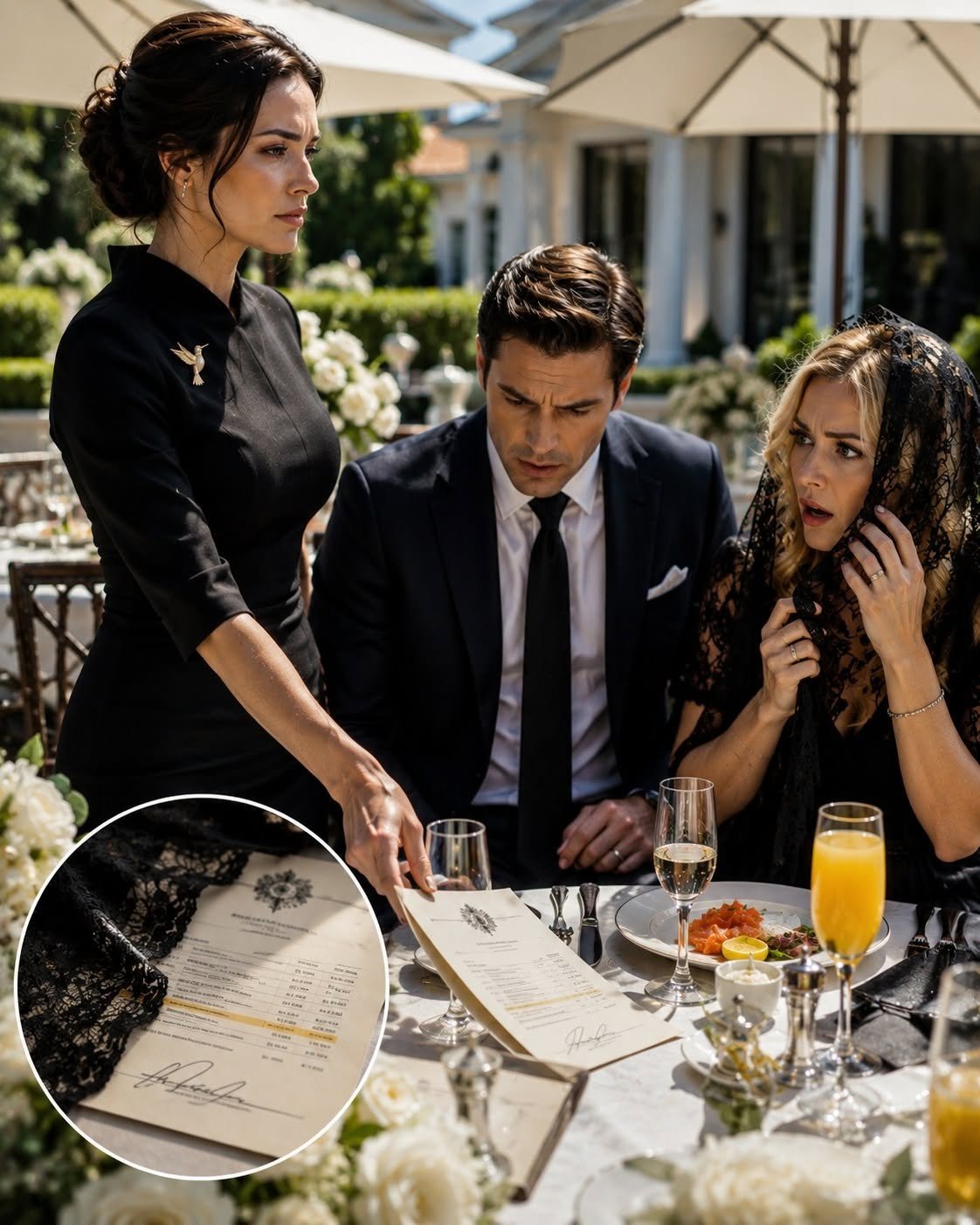
His mistress wore a black veil to brunch and joked that she was mourning my marriage.
Not my mother, who had been buried ninety minutes earlier under a gray Tennessee sky.
Not the woman who taught me how to braid my hair, balance a checkbook, and leave a room before begging for love.
My marriage.
That was what Sloane Mercer thought deserved the veil.
She sat beneath the white umbrellas at Belle Meade Country Club with a mimosa in one hand and my husband’s fingers resting on the back of her chair.
The veil fell over her glossy blonde waves like grief had been tailored for her.
My mother’s casket still smelled like lilies in my coat.
My hands still smelled like the wet earth I had dropped onto her grave.
Grant’s mother laughed first.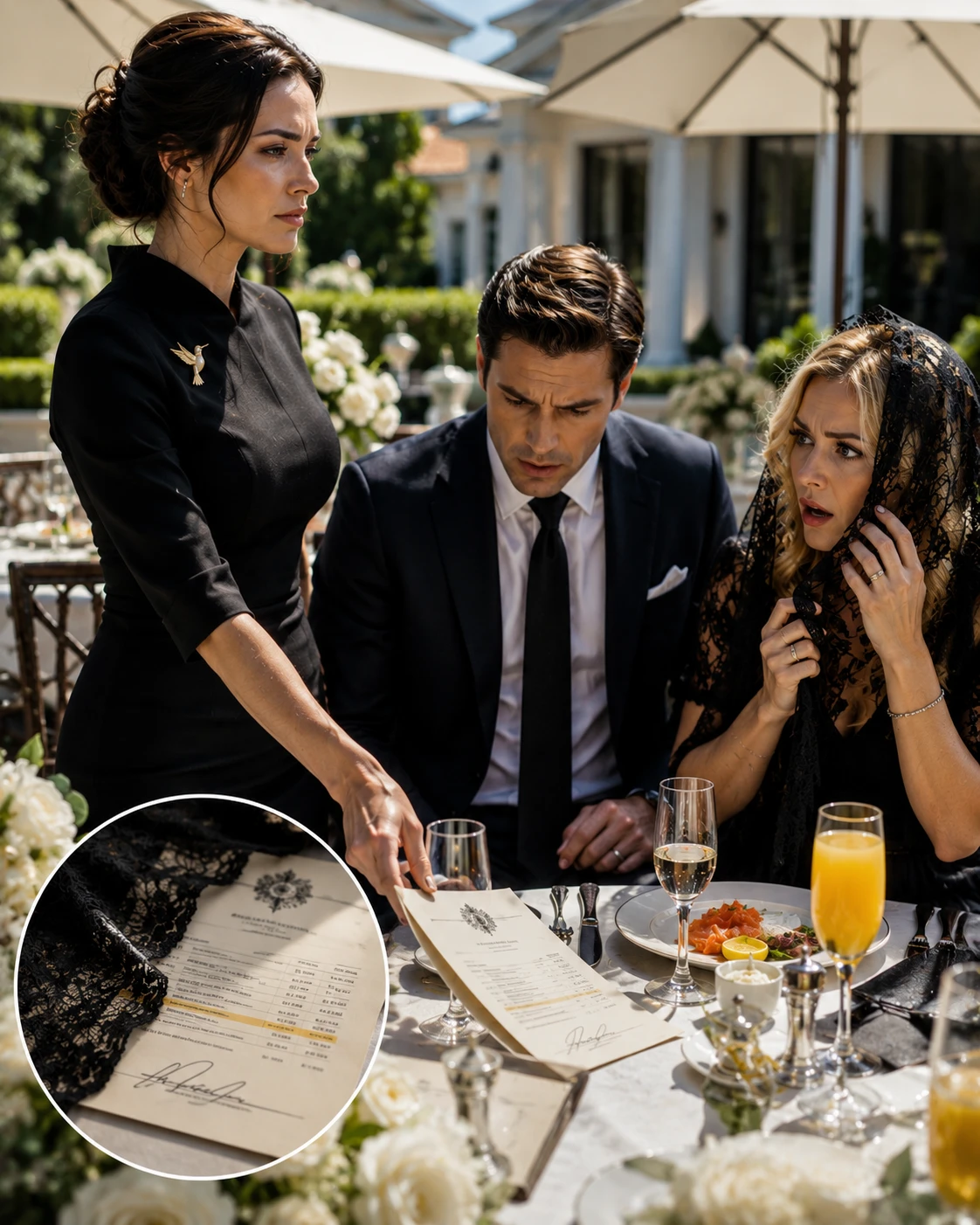
Evelyn Caldwell threw her head back, touched the pearls at her throat, and laughed the way rich women laugh when they want the whole table to know cruelty has permission.
Then everyone else laughed too.
Grant leaned toward Sloane and kissed her cheek.
He did it softly, casually, publicly, as if ten years of marriage could be erased with a mouthful of champagne and enough witnesses.
“Claire,” he said, not even looking guilty, “don’t be dramatic over a joke.”
Sloane lifted the edge of her veil and smiled at me.
“Some deaths are beautiful,” she said.
I looked at her.
I looked at my husband.
Then I opened my black purse, took out a folded invoice from Whitcomb & Sons Funeral Home, and laid it beside her champagne glass.
The table went quiet in a way laughter never survives.
“Funny,” I said.
“You used my mother’s funeral account to buy that veil.”
PART 1: The Woman Who Did Not Cry
The silence after my sentence was not peaceful.
It was the kind of silence that crawls.
Forks hovered over smoked salmon.
Ice clicked in glasses as hands shook.
My brother-in-law, Bennett, stopped chewing.
My father-in-law, Charles, stared at the invoice as if paper could bite.
Sloane did not move at first.
The black veil fluttered slightly in the spring wind, brushing against the rim of her mimosa.
Grant’s thumb slid off the back of her chair.
Evelyn’s smile stayed on her face, but it stiffened at the corners.
I had learned that look well.
It was the Caldwell family look for a servant who had forgotten her place.
That was always what I had been to them, even with Grant’s ring on my finger.
A charity case polished into a wife.
A girl from East Nashville who married into old money and was expected to remain grateful, quiet, and decorative.
My mother, Margaret Holloway, used to say old money was often just new debt wearing inherited silver.
I used to laugh when she said that.
I was not laughing now.
Sloane blinked down at the invoice.
It was printed on thick cream paper, with the funeral home’s black crest at the top.
Under the line marked “unauthorized disbursement,” there were three charges.
Elan Noire Boutique, Green Hills Mall.
Six hundred and eighty-nine dollars.
The Hermitage Hotel bar.
Two hundred and forty-three dollars.
Belle Meade Country Club florist deposit.
One thousand dollars.
All charged to the Margaret Holloway Memorial Expense Account.Preview
All posted two days after my mother died.
All signed by Grant Caldwell.
And one of them, very clearly, had bought the veil that was now sitting on Sloane’s head like a dare.
Grant gave a short laugh.
It sounded fake even to him.
“What is this supposed to be?”
“A receipt,” I said.
“For what?”
“For exactly what I said.”
Sloane lowered the veil back over her face.
It was a strange choice.
Maybe she thought it hid her.
It did not.
It only made her look like the villain in a story she had not realized had witnesses.
Evelyn reached for the invoice, but I placed two fingers on it before she could pull it away.
“No,” I said.
The word was quiet.
That made it worse.
Grant’s jaw tightened.
“You’re embarrassing yourself.”
“No,” I said again.
“I am finally embarrassing the right people.”
The country club patio had been reserved under the Caldwell name.
There were white roses on every table, an oyster bar near the hedge, and a string quartet playing something tasteful enough to be expensive and forgettable.
Evelyn had insisted on the brunch.
She said mourners needed food.
She said family needed unity.
She said my mother would have wanted me surrounded by people.
My mother would have wanted me home in sweatpants, eating fried chicken from Prince’s and watching the hummingbirds fight outside her kitchen window.
My mother would not have wanted Sloane Mercer at the table.
But Evelyn had invited her.
Not as Grant’s mistress, of course.
That would have been too honest.
Sloane was introduced as “a close family friend” and “the woman helping Grant through a difficult season.”
The difficult season, apparently, was being married to a woman whose mother had just died.
I had arrived in the black dress my mother picked out for me years ago, because she had always been practical about death.
“Don’t let them put you in something ugly when I go,” she had told me once.
So I wore the dress.
I pinned her tiny gold hummingbird brooch to my collar.
I walked into the brunch with dirt under one fingernail and a grief so heavy I felt almost calm beneath it.
That calm unsettled them.
They had prepared for tears.
They had prepared for a scene.
They had prepared for me to fall apart so they could call me unstable later.
I knew because Grant had used that word all week.
Unstable.
Emotional.
Fragile.
Difficult.
He had said them on phone calls he thought I was too numb to hear.
He had said them to Evelyn in the hallway outside my mother’s hospital room.
He had said them to Sloane on our back porch at midnight, when he thought grief had made me deaf.
But grief did not make me deaf.
It made me precise.
Evelyn lifted her chin.
“Claire, darling, today is not the day.”
I turned to her.
“Then why did you make it a stage?”
Her nostrils flared.
Nobody at that table was used to me answering back.
For ten years, I had swallowed remarks like pills.
I smiled when Evelyn corrected my grammar in front of guests, even though she said “between you and I” at least once a week.
I thanked her when she gave me skin-care samples for Christmas and said, “Stress ages working-class women faster.”
I stayed silent when she told Grant I had trapped him with kindness because I had no pedigree.
I stayed silent because I loved him.
Then I stayed silent because I was ashamed.
Then I stayed silent because my mother got sick, and I had no room left in my body for war.
Now my mother was gone.
And there was room.
Grant leaned toward me.
His voice dropped.
“You need to stop.”
I looked at his hand.
He was still wearing his wedding ring.
I wondered if he had worn it while signing my mother’s account voucher.
I wondered if Sloane had kissed that ring before she asked him whether the veil made her look tragic or iconic.
“I stopped already,” I said.
“That is what you are feeling.”
Bennett let out a low whistle.
Evelyn snapped, “Bennett.”
He raised both hands.
“I did not say a word.”
But he was smiling.
Not warmly.
Not kindly.
Bennett had always enjoyed watching Grant bleed a little because Grant had always been the favorite son.
Charles Caldwell cleared his throat.
He had been quiet all morning, the way weak men are quiet when strong women are being cruel for them.
“Claire,” he said, “perhaps we can discuss this privately.”
“Why?”
The question landed flat.
Charles looked startled.
I continued.
“The charges were public enough.”
Sloane finally spoke.
Her voice was thinner now.
“I had no idea where the money came from.”
That was almost believable.
Sloane had built a life on not knowing where money came from.
She knew where to stand for photographs, which champagne paired with lobster, and how to say “he understands me” about another woman’s husband.
But accountability was not in her skill set.
Grant straightened.
“This is absurd.”
He picked up the invoice.
This time, I let him.
His eyes moved over the numbers.
Then over his own signature.
Then over the copy of the store receipt attached behind it.
I watched the color drain from his face.
Sloane watched him too.
That was the first moment I understood she did not know everything.
She knew about the affair.
She knew about the divorce papers Grant had asked me to sign.
She knew about the condo in Midtown he had rented for her under his company account.
She knew about the brunch being a humiliation disguised as community.
But she had not known he stole from a dead woman’s funeral account to accessorize the humiliation.
That was new to her.
Good.
Truth is better when it has multiple victims.
Grant folded the invoice too slowly.
“You went through my things.”
“No.”
“Then where did you get this?”
I looked toward the French doors leading into the club dining room.
“From the person who is here to finish what my mother started.”
As if summoned by the sentence, a woman in a navy suit stepped onto the patio.
She was tall, silver-haired, and carried a leather folder like a weapon.
Behind her came a younger man with a rolling briefcase.
The string quartet stumbled.
Not stopped.
Stumbled.
Because even musicians know when money is about to change hands.
The woman paused near the hostess stand and surveyed the table.
Her eyes found me.
I nodded once.
She walked forward.
Evelyn’s expression changed from annoyance to alarm.
Grant whispered, “Who the hell is that?”
I did not whisper back.
“That is my mother’s attorney.”
The woman stopped beside my chair.
“Good afternoon,” she said.
“My name is Marian Whitaker, and I represent the estate of Margaret Anne Holloway.”
She placed the leather folder on the table.
Then she looked directly at Grant.
“I also represent Mrs. Claire Holloway Caldwell in the matter of financial abuse, marital fraud, and the attempted coercion of a grieving spouse.”
PART 2: The Marriage They Thought Was Already Dead
Ten years earlier, Grant Caldwell had proposed to me under the broken neon sign outside a diner on Gallatin Avenue.
That was the version of him I married.
Not the country club prince.
Not the man who measured people by their last names.
Not the husband who would eventually look at my mother’s hospital bed and complain that hospice smelled depressing.
The Grant I married was twenty-eight, funny, reckless, and wearing a cheap tie because his father had cut off his allowance after he quit law school.
He said he wanted to build something real.
I believed him because I wanted to believe beautiful things could still be true when rich men said them.
My mother did not dislike him at first.
She did not trust him either.
There was a difference, and Maggie Holloway lived her life inside that difference.
“He smiles too much when he wants something,” she told me after meeting him.
I rolled my eyes.
“Mom.”
“What?”
“You think everybody wants something.”
“That is because everybody does.”
But she hugged him at our wedding.
She danced with him to “Stand by Me.”
She gave us the down payment for our first house when Grant’s business ran into what he called a temporary cash-flow issue.
Temporary lasted seven years.
My mother never said I told you so.
That was not her style.
She showed up with groceries.
She paid the hospital bill after my miscarriage when Grant’s insurance had lapsed because he forgot to renew it.
She sat with me on the bathroom floor while I bled and Grant texted clients from the driveway.
She did not hate him then.
She waited.
My marriage died slowly, which is the cruelest way for a marriage to die.
It did not collapse in a single affair or a single lie.
It died in sighs.
It died in Grant saying, “Can you not start?” when I had not started anything.
It died in me apologizing for the tone he had invented.
It died in dinners where Evelyn spoke to me like a guest who had overstayed the charity of the house.
It died in the way Grant stopped saying my name unless he was irritated.
Then Sloane Mercer arrived with a clipboard, a blowout, and a laugh calibrated for men who liked feeling younger than they were.
She was hired to plan the Caldwell Foundation’s spring gala.
By June, Grant was calling her brilliant.
By August, Evelyn was calling her refreshing.
By October, I was finding gold hairpins in the passenger seat of my husband’s Range Rover.
When I asked him about them, he said I was paranoid.
When I showed him one, he said I was pathetic.
When I cried, he said tears were manipulation.
After my mother was diagnosed with pancreatic cancer, everything became simpler and more terrible.
I moved into her little brick house in East Nashville four nights a week.
I drove her to chemo.
I counted pills.
I learned which soups she could keep down.
Grant visited twice.
The first time, he brought grocery-store flowers and checked his phone beside her recliner.
The second time, he asked my mother if she had “finalized her paperwork,” and she smiled at him with the kind of calm that should have frightened him.
“I have,” she said.
Grant squeezed my shoulder.
“Good.”
My mother looked at his hand on me.
Then she looked at me.
I remember that look because it was not pity.
It was instruction.
Wake up, baby.
That was what her eyes said.
Wake up before they bury you too.
Three weeks before she died, she asked me to bring her old metal recipe box.
I thought she wanted the coconut cake card.
Instead, she opened the box and took out a small brass key.
“Storage unit,” she said.
I sat on the edge of her bed.
“What storage unit?”
“The one where I keep the things people think women like me do not keep.”
That sentence was so perfectly my mother I almost smiled.
Inside the storage unit were twelve banker’s boxes.
They contained every check she had written to Grant’s companies.
Every loan agreement.
Every email where he promised repayment.
Every text where Evelyn suggested my mother should be grateful to help “secure Claire’s position in the family.”
Every bank statement showing that Grant’s temporary cash-flow issue had become a permanent dependency.
There were also photographs.
Sloane and Grant outside the Hermitage Hotel.
Sloane and Grant at a charity dinner in Franklin.
Sloane wearing my anniversary earrings, which Grant had told me were being cleaned.
I stood between the boxes with my mother leaning on her cane beside me.
My body went cold in a way that never fully warmed again.
“Why did you not tell me?” I asked.
She touched my face.
“Because you were not ready to leave.”
I shook my head.
“That was not your choice.”
“No,” she said.
“It was my job to make sure you could leave when you were.”
Then she told me about Marian Whitaker.
Marian had been her attorney for six years.
My mother had hired her after Grant asked for the deed to my mother’s house to use as collateral.
He had framed it like a family strategy.
He had told me it would save his company.
He had told my mother it would protect my future.
My mother had smiled, made coffee, and hired a lawyer the next morning.
She never signed the deed.
Grant forged a scanned version anyway.
He did not know the bank rejected it because Marian had already filed a fraud alert on the property.
He also did not know my mother had been quietly buying pieces of his debt through a holding company Marian created.
At first, I did not understand.
My mother explained it with the patience of someone teaching a child how to fold towels.
Grant’s company, Caldwell Urban Development, was not as successful as his family pretended.
It owed money to contractors, banks, and private lenders.
Some of that debt was secured by assets.
Some of it was unsecured and ugly.
My mother, using settlement money from a medical malpractice case she had never told me about, bought enough of that debt to matter.
Then she placed it in a trust.
For me.
I remember laughing once, sharply.
“You bought my husband’s debt?”
She coughed into a tissue.
“No, honey.”
Her eyes glittered.
“I bought your freedom.”
I wanted to be angry with her.
Part of me was.
Not because she had done it, but because she had been preparing for the end of my marriage while I was still praying over its corpse.
But by then, anger was too expensive.
Cancer had taught us to spend only what mattered.
So I sat beside her bed and listened.
She had also changed her funeral account.
Not a simple prepaid plan, like most people use.
A separate memorial expense account had been opened with strict authorization rules.
Only three people had legal access.
My mother.
Marian.
And me.
Grant was not on it.
Evelyn was not on it.
No Caldwell was on it.
If charges appeared under Grant’s signature, Marian said, that would mean someone had either stolen authorization documents or persuaded a vendor to ignore the account rules.
The day after my mother died, I found the envelope missing from her kitchen drawer.
It contained the funeral account card, emergency instructions, and the list of hymns she wanted.
Grant had been in the house that morning.
He said he came to help.
He left with a bakery box and my mother’s envelope.
That was when my grief became a blade.
I did not confront him.
Not at the hospital.
Not at the funeral home.
Not when Evelyn told me the Caldwell family would “host something dignified” after the burial.
Not when Grant placed divorce papers on my mother’s kitchen table and said, “It may be cleaner to handle this before emotions get worse.”
Cleaner.
He used that word while my mother’s oxygen tank still stood in the corner.
I looked at the papers.
He had already signed.
Sloane’s handwriting was on the sticky tabs.
The agreement gave me the East Nashville house, which he had no right to give.
It gave him our Belle Meade property, which was partly purchased with my mother’s money.
It waived my claim to his business.
It sealed all financial disclosures.
It included a clause requiring me to make no disparaging public statements about him, his family, or any future partner.
Any future partner.
There are insults that come dressed as legal language.
I picked up the pen.
Grant exhaled.
Then I set it down.
“I will read it after the funeral,” I said.
His face tightened.
“You are making this harder.”
“No,” I said.
“You are.”
That night, I called Marian.
The next morning, I buried my mother.
Then I went to brunch.
PART 3: The Veil Comes Off
Marian Whitaker did not ask permission to sit.
She took the empty chair beside me, opened her leather folder, and removed a stack of documents held together with a brass clip.
The younger man stood behind her with the rolling briefcase.
He looked like an accountant who had learned to enjoy funerals.
Evelyn found her voice first.
“This is highly inappropriate.”
Marian glanced at the black veil still covering Sloane’s face.
“I agree.”
Sloane flinched.
Grant leaned back in his chair and tried on his courtroom expression, though he had never passed the bar.
“Marian, was it?”
“Mrs. Whitaker,” she said.
His smile twitched.
“Mrs. Whitaker, my wife is grieving and confused.”
I folded my hands in my lap.
There it was.
The sentence he had rehearsed.
Grieving and confused.
Soft enough for sympathy.
Sharp enough for control.
Marian turned one page.
“Mrs. Caldwell is neither.”
Grant laughed.
“My family is not discussing private finances in the middle of brunch.”
“No,” Marian said.
“You are discussing criminal exposure, marital assets, and a deceased woman’s estate in the middle of brunch.”
Bennett made the low whistle again.
Evelyn slapped the table with her palm.
“That is enough.”
For the first time, Marian looked at her fully.
“Mrs. Caldwell, your name appears in fourteen communications relating to the concealment of community assets from my client.”
Evelyn went pale under her foundation.
“I have no idea what you mean.”
“That is unfortunate,” Marian said.
“You wrote most of them.”
Sloane pushed her chair back slightly.
The legs scraped against the stone patio.
Grant shot her a look.
She stopped moving.
It was a small thing, but I saw it.
A leash jerking tight.
Once, I would have felt sorry for any woman caught in that look.
Today, I simply noticed it and kept breathing.
A waiter approached with a silver tray of crab cakes, saw the table, and made a graceful retreat.
Marian lifted the invoice.
“Let us begin with the veil.”
Sloane’s hand went to her head.
“I said I did not know.”
“That may be true,” Marian said.
“Unfortunately, ignorance does not return stolen estate funds.”
Sloane looked at Grant.
“Stolen?”
Grant’s voice sharpened.
“Do not be ridiculous.”
Marian slid a copy of the receipt toward Sloane.
“Elan Noire Boutique noted the purchase as a black mourning veil, imported lace, charged to card ending in 4419.”
She placed another document beside it.
“Card ending in 4419 belongs to the Margaret Holloway Memorial Expense Account.”
Sloane stared at the paper.
Then she looked at Grant with something new in her eyes.
Not guilt.
Fear.
“You told me it was a family account,” she said.
Grant’s mouth opened.
Nothing came out.
Evelyn recovered enough to sneer.
“Oh, for heaven’s sake, it is a few hundred dollars.”
That sentence did what my grief could not.
It woke everyone at the table.
Even Charles looked at her.
A few hundred dollars.
For a veil bought with the money set aside to bury the woman who had fed me, raised me, and paid their son’s debts.
I watched Evelyn realize she had said the quiet thing out loud.
She covered it badly.
“What I mean is, surely this can be reimbursed.”
Marian nodded.
“Reimbursement is one option.”
Grant’s shoulders lowered slightly.
“Thank you.”
“Prosecution is another.”
His shoulders rose again.
Marian removed a small digital recorder from her folder and placed it in the center of the table.
Grant froze.
I did too, but for a different reason.
I knew what it was.
My mother had made the recording three days before she died.
She was too weak to hold the device herself, so I held it near her mouth.
She insisted on wearing lipstick.
She said if she was going to haunt a room, she wanted to look alive doing it.
Marian pressed play.
For a moment, there was only static.
Then my mother’s voice came through the little speaker.
Thin.
Raspy.
Unmistakable.
“My name is Margaret Anne Holloway, and I am of sound mind, though my body is making a dramatic argument otherwise.”
A sound escaped me.
Not a sob.
Almost a laugh.
My mother.
Even dying, she knew how to enter a room.
The table sat motionless.
Sloane slowly lifted the veil off her face.
The lace pooled in her lap like spilled ink.
My mother’s voice continued.
“If this recording is being played, it means my daughter Claire is in a room where someone has mistaken her silence for weakness.”
Grant looked at me.
I looked at the recorder.
“I raised her better than that, but love can make even smart women patient with fools.”
Bennett covered his mouth.
Evelyn whispered, “This is grotesque.”
Marian paused the recording.
“No, Mrs. Caldwell.”
She looked at Evelyn’s pearls.
“What happened before I arrived was grotesque.”
Then she pressed play again.
My mother’s voice filled the patio.
“Grant, if you are hearing this, I want you to know I gave you more chances than you deserved because my daughter loved you.”
Grant stared down at his plate.
“I wrote checks when I should have written warnings.”
“I kept records because women without records get called crazy.”
“I watched you drain her joy and call it marriage.”
“I watched your mother polish cruelty until it sounded like etiquette.”
Evelyn stood.
Charles grabbed her wrist.
“Sit down,” he whispered.
She did.
My mother breathed hard on the recording.
I remembered that breath.
I remembered wanting to stop her.
She would not let me.
“I have left Claire my house, my accounts, my trust, and my full interest in Holloway Holdings.”
Grant’s head snapped up.
Marian paused the recording again.
He looked at her.
“What the hell is Holloway Holdings?”
Marian’s face did not change.
“The entity that acquired a controlling position in several notes attached to Caldwell Urban Development.”
Charles dropped his fork.
It hit the plate with a bright, ugly sound.
Bennett sat up straight.
Grant’s face moved through confusion, disbelief, calculation, and finally panic.
“No,” he said.
Marian opened another document.
“Yes.”
Sloane looked between them.
“What does that mean?”
It was Bennett who answered, softly and with unmistakable pleasure.
“It means Claire’s mother owned Grant’s debt.”
Marian corrected him.
“Owns, through the trust now controlled by Claire.”
Grant pushed back from the table.
“You cannot just buy someone’s company.”
“No,” Marian said.
“But you can acquire debt, enforce covenants, and pursue remedies when the borrower commits fraud.”
I watched Grant’s hands.
They had always given him away.
When he lied, he touched his cufflinks.
When he was afraid, he curled his fingers into his palms until his knuckles whitened.
Right then, both fists were closed.
Marian continued.
“Mr. Caldwell, you personally guaranteed three of those notes.”
Charles closed his eyes.
Evelyn said, “Grant?”
Grant ignored her.
Marian slid a document toward him.
“Those notes include morality and disclosure covenants you signed when seeking a bridge extension nine months ago.”
Sloane whispered, “Morality?”
Grant muttered, “It is standard language.”
Marian looked at me.
I nodded.
She went on.
“The agreement defines concealment of marital assets, fraudulent use of estate funds, and coercive presentation of divorce documents as triggering events.”
Grant’s voice rose.
“That is absurd.”
“Your signature is not.”
She turned the page so everyone could see it.
There it was.
Grant Caldwell, in blue ink, under a paragraph he had never bothered to read because men like him assume fine print is for smaller people.
Sloane pushed the veil off her lap like it had burned her.
“You told me she had nothing.”
Grant glared at her.
“This is not the time.”
She gave a short, stunned laugh.
“Oh, now timing matters?”
Evelyn turned on Sloane.
“You will be quiet.”
Sloane turned back.
“I have been quiet for six months while you people promised me a ring, a condo, and a clean exit from his miserable wife.”
The entire table inhaled.
There are moments when even betrayal betrays itself.
Grant looked murderous.
Sloane was too scared to stop.
“She was supposed to sign today,” Sloane said, pointing at me.
“You said she would be too broken after the funeral to fight.”
I felt the words enter me.
Not as shock.
As confirmation.
The final signature on something my body had already known.
Marian’s young assistant removed a slim tablet from the briefcase.
“Thank you, Ms. Mercer,” Marian said.
“For clarity, are you stating Mr. Caldwell intended to procure Mrs. Caldwell’s signature on a divorce agreement immediately following her mother’s funeral while she was under extreme emotional distress?”
Sloane blinked.
Grant barked, “Do not answer that.”
Sloane looked at him.
For once, the mistress and the wife understood the same thing at the same time.
He would feed anyone to the fire if it kept him warm.
“Yes,” Sloane said.
Her voice trembled.
“That is what he said.”
Marian’s assistant tapped the tablet.
“Noted.”
Grant stood so quickly his chair fell backward.
Several people at nearby tables turned.
He pointed at me.
“You planned this.”
I looked at him for a long moment.
Then I said the truest thing I had said in years.
“No, Grant.”
“You did.”
“No.”
I rose slowly.
My knees were shaking, but nobody needed to know that.
“My mother planned for the day you forced me to stop pretending.”
PART 4: The Dead Woman’s Letter
Grant tried to leave.
That was his instinct when rooms no longer adored him.
He liked exits that looked like strategy.
He reached for his phone with one hand and his car keys with the other.
Before he could step away, Marian’s assistant spoke.
“Mr. Caldwell, your vehicle is currently being secured by the lender.”
Grant turned.
“What?”
The assistant checked the tablet.
“The Range Rover parked under valet ticket eighty-two is listed as collateral under Caldwell Urban Development’s executive asset line.”
Grant looked at Marian.
“You cannot take my car.”
“I am not taking it,” Marian said.
“The secured lender is enforcing the default provision.”
“That car is in my name.”
“It is in the company’s name.”
Sloane covered her mouth.
Bennett leaned back as if he had just ordered dessert.
Then Grant’s phone rang.
The ringtone sounded obscene in the silence.
He looked at the screen.
His face changed.
Marian watched calmly.
“You may want to answer.”
He did.
“This is Grant Caldwell.”
He listened.
His eyes moved to me.
Then to Marian.
Then to his mother.
“No, that is not possible.”
He listened again.
“What do you mean frozen?”
Evelyn whispered, “Grant?”
He turned away from the table, but his voice carried.
“There has been a mistake.”
More silence.
“No, she is my wife.”
Another pause.
“We have joint accounts.”
He looked at me with hatred sharp enough to cut meat.
I remembered all the times that look would have made me apologize.
Now it only made him look small.
Grant ended the call.
Marian spoke before he could.
“Your personal cards tied to the marital line of credit have been frozen pending investigation.”
Evelyn rose halfway from her chair.
“You froze my son’s accounts?”
“No,” Marian said.
“The bank froze access after receiving notice of disputed charges, suspected fraud, and pending litigation.”
Charles whispered, “Dear God.”
Marian turned to him.
“Mr. Caldwell, your trust distributions are separate, but any transfer made to Grant in the last ninety days may be subject to review.”
Charles aged ten years in one breath.
Evelyn did not comfort him.
She was too busy staring at me as if she could still make me disappear by disapproving of my posture.
“You ungrateful little girl,” she said.
The patio froze again.
There it was.
Not Claire.
Not my daughter-in-law.
Not grieving wife.
Little girl.
I smiled faintly.
My mother would have loved that.
Evelyn continued, voice shaking with rage.
“My family gave you a name.”
I touched the hummingbird brooch at my collar.
“No, Evelyn.”
“My mother gave me a name.”
“And unlike yours, she did not have to borrow money to keep it polished.”
Bennett choked on his champagne.
Evelyn’s face went crimson.
Grant took one step toward me.
Marian did not raise her voice.
“Mr. Caldwell, I recommend you remain exactly where you are.”
He stopped.
Not because he respected Marian.
Because every rich man knows the sound of legal consequences entering the room.
Marian opened the folder again.
“There is one final matter.”
I knew this part too.
Still, my stomach tightened.
Marian pulled out an envelope.
It was cream-colored, sealed with my mother’s crooked handwriting across the front.
For my Claire, when the room gets cold.
My throat closed.
I had read it once.
Only once.
Marian held it out to me.
I took it.
The paper felt warmer than it should have.
“Would you like me to read it?” Marian asked quietly.
I shook my head.
I unfolded the letter myself.
My hands were not steady anymore.
But my voice was.
“My darling Claire,” I read.
“If you are reading this in front of the Caldwells, I am sorry they waited until I was gone to show you who they always were.”
Evelyn made a disgusted sound.
I kept reading.
“Do not hate yourself for loving Grant.”
“People like him do not begin with cruelty.”
“They begin with charm, and charm is just a locked door painted yellow.”
Sloane started crying silently.
I did not look at her.
“Do not waste your life proving you were good enough for people who needed you small.”
“You were never small.”
“You bent yourself around their furniture until you forgot you were a house.”
My voice cracked on that line.
I stopped.
The country club blurred.
For a second, I was not on a patio with my husband and his mistress.
I was eight years old, standing on a kitchen chair while my mother taught me how to stir biscuit dough.
I was sixteen, crying because girls at school called our house trashy, and my mother said, “Baby, trash is what people throw away, not where they come from.”
I was thirty-five, lying beside her hospital bed, listening to her breathe like each inhale had to climb a mountain.
Marian put a hand on my back.
I kept reading.
“I have put the house in your name alone.”
“The East Nashville house is yours because every woman deserves one door that no one can lock against her.”
“The trust is yours because freedom costs money and I will not apologize for giving you some.”
“Caldwell Urban Development’s debt is yours to enforce, forgive, restructure, or burn down legally, depending on your mood and your attorney’s advice.”
Bennett laughed once, then covered it with a cough.
Even Marian’s mouth twitched.
I read on.
“Grant, if you are listening, repay what you owe.”
“Not just the money.”
“The peace.”
“The years.”
“The daughter you borrowed and returned tired.”
Grant looked away.
Good.
I wanted him to hear every syllable and find no mirror kind enough to soften it.
“Evelyn, you were cruel to my child because you thought breeding was the same as character.”
“It is not.”
“Character is what you do when the waitress spills water, when the nurse says visiting hours are over, when your son hurts a woman who trusted him.”
“You failed those tests often.”
Evelyn’s mouth opened, but nothing came out.
My mother had silenced her from the grave.
There are miracles.
I continued.
“Sloane, I do not know you.”
“But I know enough to say this.”
“If a man offers you a crown made from another woman’s bones, do not call yourself a queen when it cuts your forehead.”
Sloane closed her eyes.
A tear slid under one false lash.
“And Claire,” I read, softer now.
“Do not stay for revenge.”
“Revenge is a match.”
“Freedom is a sunrise.”
“Use the match only long enough to see the door.”
I lowered the letter.
The patio was so quiet I could hear the fountain beyond the hedge.
Then Marian removed one more document.
Grant groaned.
“Oh, my God, there is more?”
“Yes,” Marian said.
“There is.”
She looked at me for permission.
I gave it.
Marian addressed the table.
“Mrs. Holloway also left specific instructions regarding her memorial meal.”
Evelyn stiffened.
“This brunch was arranged by our family.”
“No,” Marian said.
“This brunch was charged in part to Mrs. Holloway’s memorial account without authorization.”
She looked toward the white roses.
“Mrs. Holloway requested no white roses.”
The florist deposit suddenly looked less elegant.
It looked like evidence.
Marian continued.
“She requested fried chicken, biscuits, peach preserves, strong coffee, and coconut cake served at her home to anyone who loved Claire enough not to make her grief about themselves.”
My laugh came out broken.
My mother had hated country club food.
She said rich people turned lunch into foam and garnish because they were afraid of hunger.
Marian removed a check from the folder and placed it in front of me.
“Mrs. Holloway anticipated that others might attempt to redirect her memorial funds.”
Of course she had.
My mother anticipated storms, late fees, male incompetence, and southern women with floral agendas.
“This cashier’s check reimburses the account from a personal reserve she established.”
Marian looked at Grant.
“The estate will still pursue recovery of unauthorized charges.”
Grant stared at the check.
Something ugly moved across his face.
“You people are acting like I robbed a grave.”
I looked at him.
“You dressed your mistress with one.”
That ended him for a moment.
Not forever.
Men like Grant do not end all at once.
They regroup.
They rename.
They explain.
They find new rooms full of people who have not read the documents.
But in that room, on that patio, in front of his family, his mistress, his banker on the phone, and my mother’s attorney, he ended enough.
Sloane stood.
The black veil fell from her lap to the patio stone.
Nobody picked it up.
“I am leaving,” she said.
Grant turned on her.
“Sloane, sit down.”
She laughed, but it was not a pretty laugh anymore.
It was raw and awake.
“No.”
He lowered his voice.
“Do not make this worse.”
She looked at me.
For the first time since I had known her name, she did not look triumphant.
She looked young.
Not innocent.
Young.
“I am sorry,” she said.
It was not enough.
It was still more than Grant had ever given me.
I nodded once.
She walked away from the table.
At the edge of the patio, she stopped, took off the diamond bracelet Grant had bought her for Valentine’s Day, and placed it on the hostess stand.
Then she left through the side gate, veilless.
Grant watched her go with disbelief.
He truly thought women existed in categories.
Wife.
Mistress.
Mother.
Hostess.
Problem.
He had never considered that one might simply become a witness.
Marian’s assistant looked up from his tablet.
“Ms. Mercer has texted me her email address.”
Bennett burst out laughing.
Evelyn whispered, “This family is being destroyed.”
I picked up my purse.
“No.”
I looked at each of them.
“It is being audited.”
PART 5: The House With One Door
The aftermath did not happen like movies promise.
There was no instant applause.
No dramatic police car pulling up to the country club.
No champagne thrown.
No slow-motion walk through falling petals while my husband collapsed behind me.
Real endings are mostly paperwork.
Marian drove me to my mother’s house because she did not want me driving after the letter.
On the way, Nashville rolled past the window in soft green blurs.
Dogwoods.
Brick churches.
Gas stations.
Bachelorette buses already screaming down Broadway like grief had not happened anywhere in the city.
My phone kept buzzing.
Grant.
Evelyn.
Bennett.
Unknown numbers.
I turned it off.
When we pulled into my mother’s driveway, the porch light was on.
I had left it that way that morning before the funeral.
My mother always said you should never come home to darkness if you can help it.
Inside, the house smelled faintly of lemon cleaner and the lavender lotion hospice nurses used on her hands.
On the kitchen table was a cake stand covered in foil.
Beside it was a note from Mrs. Alvarez next door.
Coconut cake.
Your mama told me the recipe was mine now, but I know better.
Eat two pieces before answering anybody.
I cried then.
Not on the country club patio.
Not at the grave.
Not while reading the letter.
I cried in my mother’s kitchen over coconut cake and a neighbor’s handwriting.
Marian sat with me.
She did not tell me I was strong.
People say that when they do not know what else to do with your pain.
She simply got plates.
We ate cake in silence.
At four-thirty, I turned my phone back on.
There were thirty-seven missed calls.
Grant had left nine voicemails.
The first was furious.
The second was legalistic.
The third was wounded.
By the fifth, he was crying.
By the ninth, he was sorry.
Not sorry for Sloane.
Not sorry for my mother.
Not sorry for the funeral account.
Sorry because the locks on his life had changed and his keys no longer worked.
I deleted them without listening twice.
That evening, Marian sent a formal notice to Grant’s attorney.
By sunrise, the story had already begun moving through Nashville in whispers.
Not because I posted it.
I did not.
At least not then.
People at country clubs are surveillance cameras with pearls.
Someone had seen the veil.
Someone had heard the line.
Someone’s daughter worked at Elan Noire.
Someone’s cousin handled valet contracts.
By noon, the phrase “the funeral veil brunch” had a life of its own.
By dinner, Bennett texted me.
For what it is worth, that was the best brunch this family has ever hosted.
I stared at the message for a long time.
Then I blocked him too.
A week later, Sloane gave Marian a sworn statement.
She admitted Grant had told her I would be “too destroyed to negotiate.”
She turned over texts.
In one of them, Grant wrote, Claire will sign anything after the service if we keep Evelyn on script.
On script.
My grief had been scheduled.
My humiliation had been catered.
My marriage had not died.
It had been murdered in committee.
The divorce moved quickly after that.
Grant fought at first.
Then the bank called again.
Then contractors came forward.
Then an old bookkeeper from Caldwell Urban Development delivered a flash drive to Marian’s office because, in her words, “Mrs. Holloway was the only person who ever treated me like I had a brain.”
The flash drive contained two sets of books.
Grant’s lawyer became much more cooperative.
Evelyn sent me one letter.
It arrived on heavy stationery, embossed with the Caldwell crest.
Claire, it began, though I am sure you feel wronged, families should settle matters privately.
I wrote three words across the bottom.
Not your family.
Then I mailed it back.
Charles called once from a number I did not recognize.
He sounded smaller than I remembered.
He apologized for remaining silent.
I believed him.
I also did not comfort him.
Some apologies are true and still arrive too late to be useful.
Sloane moved to Atlanta.
I heard she sold the bracelet and donated the money to a hospice charity under my mother’s name.
I did not know what to do with that information.
So I did nothing.
That became one of my new skills.
Doing nothing when nothing was required.
Not every wound needs a speech.
Not every villain needs a final scene.
Not every woman who hurts you deserves the rest of your life as an audience.
Three months after the brunch, I walked into the Belle Meade house Grant and I had shared and packed only what was mine.
Not what I had bought.
Not what I had chosen.
What was mine.
There is a difference.
I took my books.
My grandmother’s quilt.
The chipped blue mug my mother loved.
The photo of me at seven with missing front teeth, sitting on Maggie’s lap at the county fair.
I left the wedding china.
I left the silver-framed portraits.
I left the giant bed where I had learned how lonely marriage could be.
Grant was there.
He looked thinner.
Angrier.
More ordinary.
For years, I had thought losing him would feel like falling off a bridge.
Standing in that house, watching him watch me pack, I realized it felt more like taking off shoes that had always been half a size too small.
“Claire,” he said.
I kept wrapping the mug in newspaper.
“I loved you.”
That made me stop.
Not because I believed him.
Because once, I would have needed to.
I looked at him.
“No, Grant.”
“You loved being loved by me.”
His face twisted.
“That is not fair.”
“Neither was brunch.”
He looked down.
For a moment, I saw the man from the diner again.
The young one with the cheap tie and impossible promises.
I wondered whether he had ever existed, or whether I had built him from hunger and neon light.
“I made mistakes,” he said.
“You made choices.”
He had no answer for that.
I carried the box to my car.
At the door, he called after me.
“Are you happy now?”
I turned back.
Sunlight fell through the foyer behind him, touching the marble floors Evelyn had insisted were timeless.
He stood in the middle of all that expensive emptiness and mistook my leaving for revenge.
I almost felt sorry for him.
Almost.
“I am not happy because you lost,” I said.
“I am free because I stopped trying to win you.”
Then I walked out.
The East Nashville house became mine in every way that mattered.
At first, I changed nothing.
Grief needs familiar walls.
I kept my mother’s robe on the hook behind the bathroom door.
I kept her crossword book on the nightstand.
I kept the hummingbird feeder full because she would have haunted me over that.
Then slowly, I began to make the house ours and mine at the same time.
I painted the kitchen yellow.
Not a charming locked-door yellow.
A sunrise yellow.
I replaced the old porch steps.
I planted rosemary, tomatoes, and one dramatic hydrangea that refused to bloom until late August, which felt personal.
I turned the dining room into a small office and placed my mother’s recipe box on the desk.
Inside it, behind the coconut cake card, I kept the letter.
For my Claire, when the room gets cold.
I read it less often as time passed.
That is how I knew I was healing.
Not because I forgot.
Because I did not need to reopen the wound to prove it had been real.
The legal case settled after eight months.
Grant repaid the memorial account.
He transferred his interest in the Belle Meade house as part of the divorce.
Caldwell Urban Development was restructured under outside management.
Evelyn’s name vanished from foundation invitations for a while, which in her world was almost prison.
I did not burn his life down completely.
Not because he deserved mercy.
Because my mother was right.
Revenge is a match.
Freedom is a sunrise.
I used the match.
Then I opened the door.
The post came later.
It was not polished.
It was not strategic.
It was midnight, rain tapping against my kitchen window, and I was wearing my mother’s robe while eating leftover coconut cake from a plastic container.
I took a picture of the hummingbird brooch beside the funeral invoice.
I did not include faces.
I did not include names.
I wrote one sentence.
His mistress wore a black veil to brunch and joked she was mourning my marriage, so I showed her the receipt proving my dead mother paid for it.
I almost deleted it.
Then I heard my mother in my head.
Women without records get called crazy.
So I posted it.
By morning, my phone was unusable.
Women wrote to me from Arizona, Ohio, Florida, Maine, California, and little towns I had never heard of.
They wrote about husbands who emptied accounts.
Mothers-in-law who smiled while twisting knives.
Divorce papers served after chemo.
Mistresses seated at Thanksgiving.
Funerals turned into power plays.
They wrote, I thought it was just me.
That sentence broke my heart more than anything Grant had done.
I thought it was just me.
So I started answering.
Not all of them.
I could not.
But enough.
I shared resources.
Marian helped me build a list of legal aid groups, financial abuse hotlines, domestic violence organizations, estate planning basics, and checklists for women who needed to leave quietly.
We named it The One Door Fund.
Because of my mother’s letter.
Because every woman deserves one door no one can lock against her.
The first donation came from Mrs. Alvarez.
Twenty dollars cash in an envelope tucked under my flowerpot.
For Maggie, the note said.
The second came from Bennett, anonymously, except he was terrible at anonymous.
Then came strangers.
Then came women who had escaped and wanted to hold the door open for somebody else.
A year after the brunch, we held our first luncheon.
Not at Belle Meade Country Club.
In my backyard.
There were folding tables under string lights.
There were biscuits, fried chicken, peach preserves, strong coffee, and coconut cake.
No white roses.
No veils.
No violins pretending grief was elegant.
Just women laughing with their whole bodies because nobody at the table was waiting to punish them for being too loud.
Marian came in navy linen instead of navy wool.
Mrs. Alvarez brought extra cake.
A woman named Dana from Knoxville stood up and said The One Door Fund helped her get a lawyer before her husband could sell their house.
Another woman named Tessa said she had opened her own bank account at forty-nine.
Another said she had not left yet, but she had hidden copies of her documents and that was the first honest thing she had done for herself in years.
We clapped for that too.
Especially for that.
Because leaving does not begin at the door.
Sometimes it begins with a folder.
Sometimes it begins with a password.
Sometimes it begins with a receipt.
Near sunset, I walked into the kitchen for more coffee and found myself alone for the first time all day.
The house was loud behind me.
Alive.
My mother’s robe was no longer on the bathroom hook.
Her crossword book had been moved to a shelf.
The grief was still there, but it had changed shape.
It no longer sat on my chest.
It sat beside me.
Like something old that had learned manners.
I opened the recipe box and touched the edge of her letter.
For a second, I could almost hear her.
Not as a ghost.
As memory.
As instruction.
As love that had planned ahead.
I went back outside.
The hydrangea had finally bloomed, ridiculous and blue in the corner of the yard.
The women were talking under the lights.
Someone had started music from a little speaker.
Mrs. Alvarez was teaching Marian how to two-step, badly.
I stood on the porch and watched them.
I thought about Sloane’s black veil lying on the patio stone.
I thought about Grant asking if I was happy now.
I thought about Evelyn saying my family gave you a name.
Then I looked at my mother’s house, my mother’s people, my mother’s cake, my mother’s courage moving through strangers like a current.
I touched the hummingbird brooch at my collar.
“Yes,” I whispered.
Not because they lost.
Not because the world had become fair.
Not because grief had gone.
Because the door was open.
Because I had walked through it.
Because on the other side, there was sunlight.
WARM CONCLUSION: The Brunch I Choose Now
Every spring, on the anniversary of the funeral, I host brunch at my house.
Not a memorial.
Not exactly.
A reminder.
We put flowers on the tables, but never white roses.
We serve my mother’s food, play old Motown records, and leave one chair empty under the porch light.
Women come with stories.
Some come with court dates.
Some come with babies.
Some come with nothing but a shaking hand and a folder full of papers.
Nobody has to explain before eating.
Nobody has to prove they were hurt enough to deserve help.
Nobody tells them they are dramatic.
At the end of the meal, we write one sentence on little cards and drop them into my mother’s recipe box.
One truth we are no longer willing to swallow.
Some are simple.
I am allowed to have money.
I am allowed to leave.
I am allowed to be believed.
I am allowed to stop answering.
I am allowed to live.
Mine has stayed the same for years.
I am not the woman they laughed at.
I am the woman who kept the receipt.