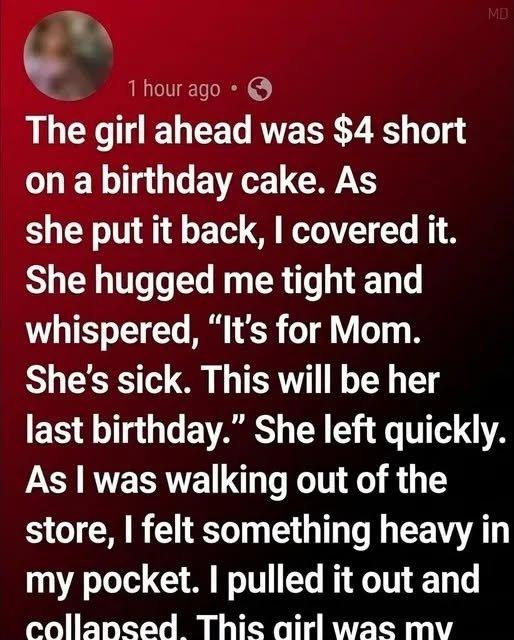
The cashier quietly slid the small birthday cake back across the counter, and the girl’s shoulders dropped. She could not have been older than thirteen, yet she did not complain or ask anyone for help. She simply stared at the pink frosting, nodded politely, and whispered, “Thank you anyway.” The store was crowded, carts rattled behind us, and impatient customers checked their phones. Still, something about the calm disappointment on her face made everything around me seem strangely quiet. Before she could walk away, I stepped forward and told the cashier to put the cake back in the bag.
The cake cost $18.99, and the girl was exactly $4 short. Her name was Lily, and she wore a faded purple jacket that looked too thin for the cold March afternoon. I handed the cashier a five-dollar bill and told her to keep the change, expecting nothing more than a quick smile. Instead, Lily wrapped both arms around me and held on as though I had done something far greater. “It’s for my mom, Claire,” she whispered. “She’s been sick, and today might be the only birthday we get to celebrate at home.” Before I could ask another question, she grabbed the cake and hurried toward the exit.
I finished paying for my groceries, but Lily’s words stayed with me as I crossed the parking lot. Near my car, I reached into my coat pocket for my keys and felt something folded beside them. It was a small piece of notebook paper with a childlike drawing of a cake, one candle, and two people holding hands. Underneath, Lily had written, “Thank you for noticing me when I didn’t know what to do.” I turned the paper over and saw an address written on the back—but beneath it was a message that made me stop breathing for a moment.
The note explained that Claire had recently returned home after several weeks of medical treatment and that Lily had been using her babysitting money to help with groceries. Their insurance covered part of the bills, but unpaid expenses were piling up beside the mortgage, and Claire feared losing the modest house her parents had left as part of their estate. The next morning, I contacted a local community organization run by an attorney who helped families avoid unnecessary court disputes and financial hardship. Within days, volunteers arranged meals, transportation, and advice about an education investment account established for Lily. No miracle erased every problem, but the family finally had room to breathe.
A week later, Lily and Claire invited me inside for coffee and a slice of leftover cake. Claire looked tired, but her smile was warm, and Lily seemed lighter than she had at the register. They thanked me repeatedly, though I knew the first five dollars had only opened a door that many others helped carry them through. I kept Lily’s note in my wallet for years afterward. It reminded me that people do not always announce when they are struggling. Sometimes the most meaningful kindness begins with simply paying attention.